Property Owners
Buying a Property in Olbia to Rent Out
Why price per square metre is not yield, how to read official OMI values, and what a non-resident buyer must settle before the deed.
In short. The price per square metre tells you almost nothing about what a property will earn. In Gallura you are not buying square metres, you are buying the length of a season — and the gap between a coastal address that works ten weeks a year and a city address that works twenty-five is larger than the gap between their prices. This guide sets out the arithmetic, where to look up values from an official source rather than a listing portal, and the few things a non-resident buyer has to settle before the deed.
Where the money actually comes from
The reasoning that misleads most first-time buyers runs like this: a flat at the sea lets for far more per night than one in town, therefore the sea earns more.
The first half is usually true. The conclusion does not follow, because annual revenue is not the nightly rate. It is:
average nightly rate × nights actually sold
And around Olbia, the number of nights sold varies by location far more than the rate does.
Two flats, one lesson
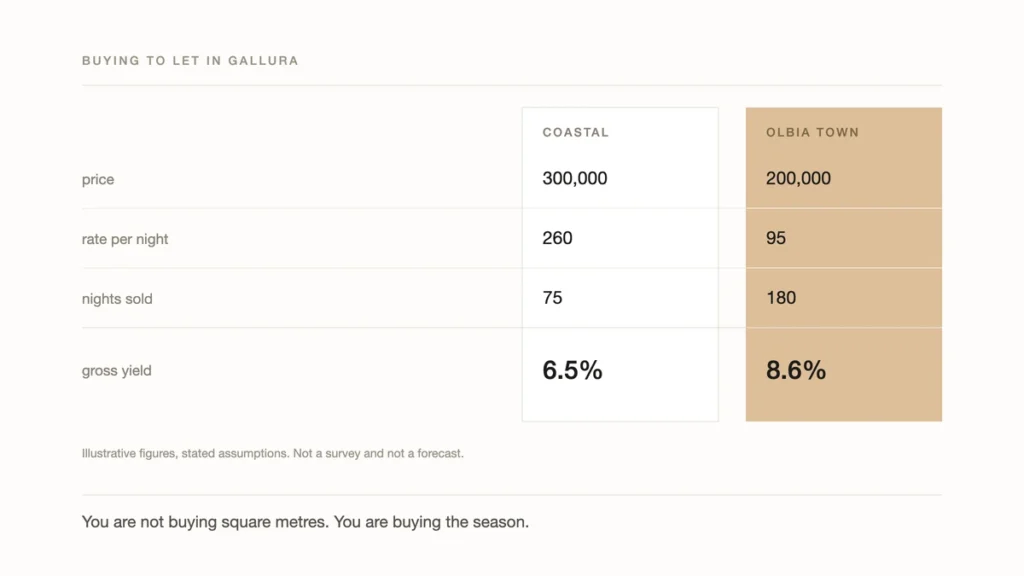
The table below is illustrative arithmetic, not a market survey. The figures are round numbers chosen to make the mechanism visible. Nothing in it is a measurement or a forecast for any real property.
| Coastal flat | Olbia town flat | |
|---|---|---|
| Purchase price | €300,000 | €200,000 |
| Average nightly rate | €260 | €95 |
| Nights sold per year (assumed) | 75 | 180 |
| Gross annual revenue | €19,500 | €17,100 |
| Gross yield on price | 6.5% | 8.6% |
The property costing 50% more produces about 14% more revenue, and a gross yield two points lower.
The point is not that town beats sea. It is that the yield is decided by the nights, and a prestigious address with a ten-week season can return a lower percentage than an ordinary one that works six months. Which of the two you want depends on whether you are buying for cash flow or for capital value — and those are different purchases, with different right answers.
The denominator almost everyone gets wrong
Here is the formula worth writing down:
Net yield = (annual revenue − annual costs) ÷ (purchase price + buying costs + renovation + furnishing) × 100
The denominator is not the purchase price. It is all the capital tied up before the first euro comes in. On a property bought to be refurbished and furnished, the real base can be materially higher than the price on the listing, and a yield calculated on the price alone flatters itself accordingly. It is the number you will find in optimistic projections.
Two practical consequences. A property needing work does not only cost the work — it costs a season of no income while the work happens, and that belongs in the plan from the start. And furnishing a short let is not furnishing your own home: it has to survive twenty changeovers a season, not two.
What you are really buying: the length of the season
If this guide came down to one sentence, it would be that in Gallura you buy the season, not the square metres.
Purely seaside locations work well from mid-June to mid-September, with a sharp peak between late July and late August. Outside that window, pure tourist demand falls away.
Olbia town is a different proposition, and it is worth understanding why: it has the main airport of northern Sardinia, a commercial and passenger port working all year, a hospital, courts and offices, and an industrial and marine sector. That generates demand which is not tourism — people travelling for work, for medical reasons, for a shipyard contract, for a relocation. Less lucrative per night, spread across twelve months.
The question to ask in front of every property is therefore not what it would fetch in August. It is:
Who would sleep here on 14 November?
If you cannot answer with a concrete figure — an engineer on a contract, a relative visiting the hospital, a northern European chasing mild weather, a seasonal worker — then it is a short-season asset. That can still be an excellent purchase. It just means the return will come mostly from capital value and from your own use of it, not from cash flow. Our guide to what a holiday rental in Olbia earns goes further into the seasonal shape.
How to look up prices properly
This matters more for a buyer abroad, who cannot calibrate by walking around.
Listing portals publish asking prices — what sellers want, not what properties sell for. They are useful, current, and systematically on the high side.
For market values there is an official, free source: the OMI quotations published by the Agenzia delle Entrate, Italy’s revenue agency. For each homogeneous zone of each comune they publish a minimum/maximum range in euro per square metre, broken down by property type and state of repair. They are half-yearly and appear with a lag — at the time of writing the most recent published half-year is the second half of 2025 — so they are not a photograph of today. They are, however, the reference your notary will use, and a valuer if one is involved.
Use both. The listing tells you what the seller is asking; the OMI range tells you whether that ask sits inside or outside the band for its zone. When a price is far above the band, there should be a reason you can point at — sea frontage, a recent full renovation, a plot — and if there is not, that is the conversation to have before the offer, not after.
As to the spread itself: on asking prices collected by listing portals in mid-2026, the gap between the cheapest inland parts of the comune and Porto Rotondo was roughly sevenfold. That is an observation of advertised prices at one moment, not an official statistic — but the order of magnitude is the point. In a comune this size, that spread is unusual, and it is the first clue that “buying in Olbia” means profoundly different things depending on where you sign.
The boundary that catches foreign buyers
This one costs people real money, because the names on a map do not follow the administrative lines.
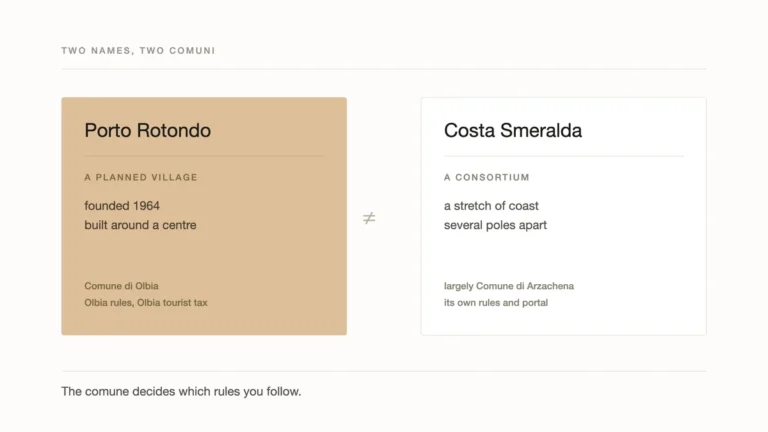
Porto Rotondo, Pittulongu, Bados, Murta Maria, Rudalza, Portisco and Berchiddeddu are districts of the Comune di Olbia. Golfo Aranci, San Teodoro, Loiri Porto San Paolo and Arzachena — which contains Porto Cervo and Baja Sardinia — are separate comuni, each with its own administration.
Why it matters when you are buying: the comune sets the IMU rates, the local taxes, the building rules and the tourist tax — its amount, its exemptions, its declaration portal and its deadlines. Two houses eight kilometres apart can carry different obligations and different recurring costs. Before you fall in love with an address, establish which comune it is in, and read that comune’s rules rather than the ones you have already learned.
Which size to buy
A studio or one-bedroom has a low entry price and high turnover, and in town it has demand all year, but the revenue per night is modest and fixed costs weigh more heavily in percentage terms. A villa commands a very high nightly rate in peak season and then stands still, with maintenance, a garden and often a pool to carry through the months it earns nothing.
In our experience of the Olbia market, the two-bedroom sleeping four to six holds up best across the year: it catches the family in August, the couple in September and the work party in November.
One detail with more effect than people expect: the number of real beds — not declared sofa beds, comfortable sleeping places. Going from four to six widens the pool of searches that find you out of proportion to what it costs to arrange, which is often one more room or one well-built bunk.
What a non-resident buyer has to settle first
None of this is difficult. It is slow if you discover it late, which is the only real risk.
- An Italian tax code. The codice fiscale is the identifier everything else hangs on — the deed, the utilities, the tax filings. Arrange it before you are in a hurry.
- How you will pay. Settle early how funds will move and whether you need an Italian account, including for the recurring costs afterwards: utilities, local taxes, maintenance.
- The deed is in Italian. It is drawn and read in Italian by the notary. If you do not understand the language, Italian notarial practice provides for an interpreter and for a translation of the deed — ask your notary in advance exactly how they will handle it and what it costs, rather than discovering it at the table.
- Whether you will be there. You can act through a power of attorney. How it must be executed abroad — before which authority, with what legalisation or apostille, in what language — is something to settle with the notary before you commit to a completion date.
- The taxes on the purchase. Buying a property in Italy carries transfer taxation, and the reduced rate attaches to conditions on residence and on not owning other property in the same comune that a non-resident buyer frequently does not meet. The amounts differ depending on whether you buy from a private seller or a business. Get the figure in writing from your notary before the preliminary contract, not after. We do not publish rates here because the one that applies to you depends on your own circumstances.
- Then the recurring ones. As a non-resident you will not have a main-home exemption on this property, so budget the IMU and the local charges from year one.
Five mistakes
Buying the house you would like for yourself. The most human and the most expensive. The house where you would want to spend August and the house that earns are not necessarily the same. Buying the first is entirely legitimate — just do the arithmetic for what it is.
Believing a yield quoted by a seller. This one earns €25,000 a year is something no seller can demonstrate. Ask: over how many nights, at what average rate, gross or net, after which costs? Nine times out of ten it is a peak gross figure projected across an optimistic season.
Ignoring the building’s rules. Condominium regulations increasingly restrict or prohibit tourist letting. The regulation has to be read before completion. If it is contractual in nature and expressly forbids the activity, that property cannot be let the way you planned — and you will have found out as an owner rather than as a buyer.
Underestimating the work. Coastal properties around Olbia often have dated installations and finishes. Add the cost of the works to the price per square metre and then add the season lost while they happen.
Not checking compliance. Cadastral discrepancies, unfinished amnesties, missing habitability certificates are common in the local building stock, and they can stop you letting even after you own the place: without compliance there is no CIN, and without a CIN you cannot advertise. This is a check to make with a surveyor before the preliminary contract.
The costs nobody counts
Yield is eroded here, not at the purchase price.
Once, on buying: transfer taxation; the notary; agency commission; survey and technical work; renovation and bringing installations up to standard; complete furnishing, linen and equipment.
Every year: IMU on a second property; utilities, which in a Gallura summer with air conditioning are not trivial; waste charges; building service charges; insurance; routine maintenance and small repairs; cleaning and linen at every changeover; platform commissions; and management, if you delegate it.
If you are weighing several properties, check where the threshold sits beyond which the activity counts as a business, because it changes the tax and contribution picture entirely: when a short let becomes a business, and how the income is taxed.
A checklist before you sign
Technical and legal
- Cadastral and planning compliance verified by a surveyor.
- Habitability certificate present.
- Condominium regulation read in full, tourist-letting clauses checked.
- Installations compliant, or the cost of making them compliant quantified.
- Cadastral category known — it affects IMU and the tourist tax.
- Which comune the property is in, confirmed, with that comune’s rules read.
Market
- I have counted the competing listings in the same area and size.
- I have checked the asking price against the OMI range for that zone.
- I have a concrete answer to who sleeps here on 14 November.
- I have estimated sellable nights by season band, not a single annual number.
Financial
- I have calculated total capital tied up, not just the price.
- All recurring costs are in the model.
- I have calculated net yield, not gross.
- The plan still works with 20% fewer nights than expected.
The last one is what saves investments. If a plan only works in the optimistic case, it is not a plan.
Frequently asked questions
Can a foreigner buy property in Italy?
Generally yes, although for citizens of some countries it depends on reciprocity arrangements between that country and Italy. It is one of the first things to confirm with the notary, together with the documents you will need. In practice the slow parts are the tax code, the funds and, if you cannot attend, the power of attorney.
Where can I check property values from an official source?
The OMI database published by the Agenzia delle Entrate. It gives a minimum and maximum value per square metre for each homogeneous zone of each comune, by property type and condition. It is free, half-yearly and published with a lag, so use it alongside current listings rather than instead of them.
Is it better to buy by the sea or in Olbia town?
It depends what you are buying for. The sea commands much higher nightly rates across a short season, which tends to favour capital value and personal use. The town has lower rates but demand spread over more months, thanks to the port, the airport, the hospital and local industry, which tends to favour cash flow.
What size of property works best for short lets in Olbia?
In our experience a two-bedroom sleeping four to six is the most balanced: it reaches families in high season and couples or work parties the rest of the year. Studios work well in town; villas earn a great deal for a few weeks and then stand still.
What yield can I expect?
Nobody can tell you without looking at the specific property. The yield depends on nights sold, weighted average rate, recurring costs and total capital tied up — four variables that differ between two flats on the same street. Treat a percentage quoted before anyone has seen the property as marketing.
Do I pay IMU if I live abroad?
Yes. A property that is not your main home attracts IMU at the rate the comune sets for that case, and it is a recurring cost from the first year. Our guide to IMU for non-resident owners sets out how it is calculated and when it falls due.
Can I buy and start letting straight away?
Only if the property is compliant and furnished. Before you can advertise anywhere you need the CIN, planning compliance and the habitability certificate. If work is required, plan on missing a season and put that in the model from the start.
The short version
Turn the usual reasoning around. Do not start from a budget and look for the nicest property that fits inside it. Start from how many nights that property can realistically sell, add how much capital it takes in total to make it operational, and only then look at the price.
Three things to take away. The price per square metre is not the yield. In Gallura you buy the season — so ask who sleeps there in November. And the denominator is all the capital you have tied up, not the price on the listing.
What this guide cannot do is tell you how many nights the property you are looking at will sell. That depends on the street, the floor, the aspect, the competition three hundred metres away and how it is run.
That is the number AirAffitti works on every day for the properties we manage in Olbia, Pittulongu, Murta Maria and Porto Rotondo. If you are weighing a purchase and want a realistic view of what it could produce before you sign, send us the property you are considering — including if you then decide against it. If you have already bought and want to put it to work, what our management covers is the place to start.
We are not a law firm, a tax practice or an estate agency, and nothing here is legal, tax or investment advice. Transfer taxation, local rules and condominium regulations have to be checked for your own case with your notary, the relevant comune and a qualified professional.
Sources
- Agenzia delle Entrate — OMI, Quotazioni immobiliari: half-yearly minimum/maximum values per square metre for each OMI zone of each comune, by property type and condition. Page consulted 6 October 2026; most recent published half-year, the second of 2025; page last updated 16 March 2026.
- Listing-portal observations of asking prices in the comune of Olbia, mid-2026, used only for the order of magnitude of the spread between zones and identified as asking prices throughout.
- Article 13-ter of Decree-Law 145/2023 — the CIN, and the requirement that it appear in every advertisement.
The worked example above is illustrative arithmetic with stated assumptions. It is not a survey, a measurement or a promise of results. Any investment decision requires analysis of the specific property.