Property Owners
When Does a Short-Term Rental Become a Business?
Two properties for tax from 2026, three units for a Sardinian C.A.V., and one test that decides the rest: in whose name the guest contracts are signed.
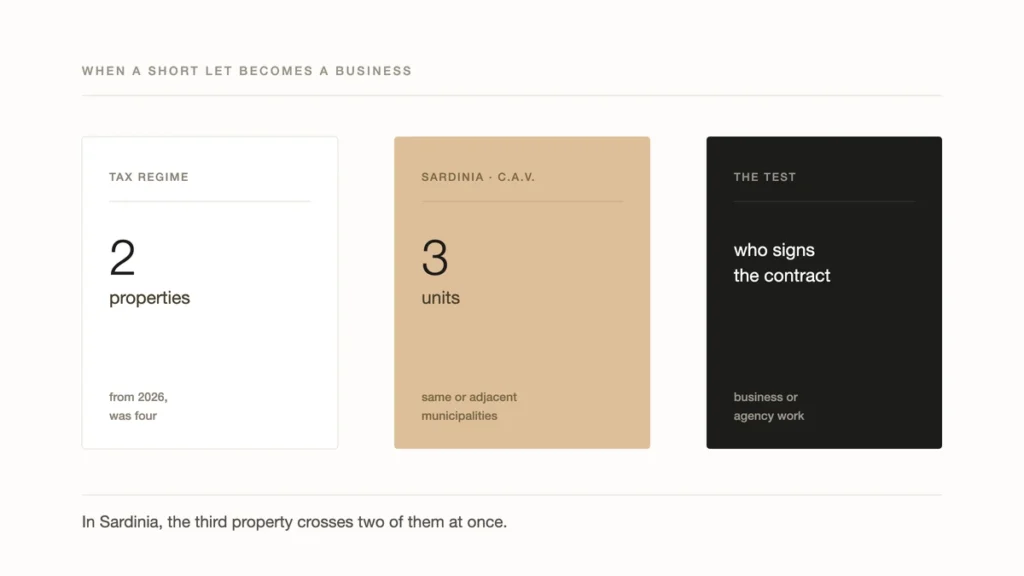
In short. Becoming a business is not a decision you make — it is a threshold that trips on its own, and in Sardinia there are three of them with different numbers. The tax threshold fell to two properties from 2026. Sardinia’s own rule turns three units into a registered accommodation business, a C.A.V. And a third criterion decides whether your manager’s activity counts as a business rather than agency work: who signs the contracts with guests. Owners who bought one flat at a time cross these lines without noticing.
Three thresholds that do not line up
The confusion comes from assuming there is one number. There are three, they come from different authorities, and they do not agree with each other:
- Tax — from 2026, more than two properties in short lets takes you out of the short-let regime.
- National administrative — the presumption of acting as a business brings its own obligations with it.
- Sardinian regional — three units managed together make a C.A.V., a proper accommodation business.
In practice, in Sardinia, the third property is where both the first and the third trip at once.
The tax threshold: two, from 2026
The Revenue Agency states it plainly. From 2026 the short-let tax regime applies only if you put no more than two properties into short lets in a given tax year. Until 31 December 2025 the limit was four. Above that, “the short-let activity, by whoever carried on, is presumed to be carried on in business form.” The change came with the 2026 budget law, law 199/2025, article 1 paragraph 17.
Read that twice if you have three or four flats. Nothing about your behaviour has changed — the threshold moved under your feet. An owner who was comfortably inside the regime in 2025 with three properties is outside it in 2026 with the same three.
Being outside means no cedolare secca on that income. You move into business income, with VAT registration, bookkeeping and obligations that were not there before.
Two details decide whether this catches you. The count looks at properties put into short lets during the tax year, not properties you own — a house kept for your own use does not enter it. And the limit is assessed per taxpayer, so joint owners are counted separately.
Sardinia’s own threshold: the C.A.V. at three
Here the region adds a rule of its own, and it matters to anyone with property around Olbia and the coast. Reach three units in the same municipality or in adjacent ones, and what you have is no longer occasional letting: it is a Casa e Appartamenti per Vacanze, a non-hotel accommodation business under regional law 16/2017, to be registered through the regional one-stop portal and run in business form.
But the regional text is more precise than a bare count, and the precision works in your favour. A C.A.V. is defined as furnished residential units, in the same or adjacent municipalities, of which the operator has availability that is “not occasional and organised”, numbering not fewer than three, managed as a single operation in business form for letting to tourists.
So owning three houses is not automatically a C.A.V. What counts is how you hold them and how you run them. Three properties let sporadically, with no common organisation, are not the same thing as three properties run together as one operation. The distinction is real, and it is the regional text that draws it — but it is also the kind of distinction that gets tested at a desk, so it is worth being able to show which side of it you are on.
What “adjacent municipalities” actually means
This is where owners get caught. Two flats in Olbia and one in Golfo Aranci make three — moving a property to the next town does not reset the count.
The implementing directives define an adjacent municipality as one directly bordering the municipality in which the operator has located the main seat of the activity. And the operator chooses which that is: it is the municipality the application is filed with. The choice is explicitly left to the person concerned.
What a C.A.V. has to provide — and what it may not
The definition prescribes services, not just a number. A C.A.V. must provide at least guest reception and a point of contact, and cleaning of the premises at every change of guest. Permitted alongside are the things that go with ordinary use of the property — electricity, water, wi-fi, air conditioning.
What is excluded is the serving of food and drink and any centralised, hotel-style services. The properties must also be in residential cadastral categories and meet the health and building requirements for ordinary dwellings.
The line with agency work: who signs the contract
This passage of the regional directives is the one to read if you use a manager, and it is not widely known.
Property agency work — including when carried out through online platforms — does not in itself constitute a C.A.V., provided it stays within the perimeter of agency and does not stray into managing the properties in its own name.
And then the test, stated in one line: signing the short-let contracts with guests in one’s own name is the characterising and distinguishing feature between running a C.A.V. and mere intermediation. If an agent signs in their own name, and the other requirements are met, what exists is a C.A.V. — regardless of how that person describes their own activity.
The practical consequence for an owner: it is worth knowing, in your arrangement with a manager, in whose name the contracts with guests are signed. It is a one-sentence question, and the answer places the activity on one side or the other of a regional definition. Note also that a tourist letting contract requires written form — though an exchange of offer and acceptance by email or messaging satisfies that.
SCIA: the question we cannot close for you
Anyone carrying on accommodation activity in business form files a SCIA — a notice of commencement of activity — with the one-stop business desk of the municipality where the activity takes place.
Whether that also binds someone who is a business only by force of the tax presumption is the question that matters here, and we have not found a ministerial document that settles it either way. We are not going to invent an answer. Before assuming you owe nothing, ask your municipality’s SUAP and get the reply in writing.
Is crossing the line bad news?
Not necessarily, and this is worth saying plainly because the tone of most coverage suggests otherwise.
Under the business regime you can deduct costs that the flat tax does not allow — and with three properties, costs are not a rounding error. Cleaning, laundry, maintenance, utilities, management fees, furnishing: none of it reduces your base under the cedolare secca, all of it counts in a business. For plenty of owners with three or more units the business regime is simply the more efficient one.
The problem is not becoming a business. The problem is becoming one without knowing, and finding out when someone checks.
Which leads to the only piece of advice in this guide. If you are at two units and considering a third, the calculation is not “what will the third property earn”. It is “what will the third property earn once all three are in the business regime”. Those are two very different numbers, and the second one is the real one. Our guide to what a holiday let in Olbia actually takes covers the revenue side; this is the structural cost that sits underneath it.
The obligations that do not change
Crossing into business form multiplies the paperwork but does not replace it. Everything that applied before still applies, per unit:
- a CIN and the regional IUN for every property — and the CIN applies to non-hotel accommodation businesses too, so a C.A.V. does not escape it;
- guest registration with the police and the regional statistical return;
- the tourist tax, collected and paid over per property;
- IMU, which does not care what regime you are in.
Frequently asked questions
How many properties can I let under the short-let tax regime?
From 2026, no more than two in the same tax year. Until the end of 2025 the limit was four. Above the threshold the activity is presumed to be carried on in business form, which means VAT registration and business accounting.
Is the Sardinian threshold three or two?
Three. Reaching three residential units in the same municipality or adjacent ones, held with availability that is not occasional and organised and managed as a single operation, makes a C.A.V. under regional law 16/2017. It is an administrative rule, separate from the tax one.
Two flats in Olbia and one in Golfo Aranci — how many units is that?
Three. The regional rule counts adjacent municipalities, so spreading properties across neighbouring towns does not avoid the threshold. An adjacent municipality is one directly bordering the municipality where you locate the main seat of the activity, and you choose which that is.
Does simply owning three houses make me a C.A.V.?
Not automatically. The definition requires availability that is not occasional and organised, and management as a single operation in business form. Three properties let sporadically and with no common organisation are not the same as three run together.
Does a property I keep for myself count?
Not towards the tax threshold, which looks at properties actually put into short lets during the tax year rather than at everything you own.
My manager handles everything. Does that make them a C.A.V.?
It depends on whose name the guest contracts are signed in. Under the regional directives, signing in one’s own name is the distinguishing feature between a C.A.V. and ordinary agency work, regardless of how the activity is described. It is worth asking.
Do I still need a CIN if I have a C.A.V.?
Yes. The CIN applies to non-hotel accommodation businesses as well, and it does not replace the regional identification code. Both are displayed.
Is the business regime worse than the flat tax?
Not necessarily. It allows you to deduct costs the flat tax disallows, which with three or more properties can outweigh the extra administration. It should be worked out on your own figures with an accountant, not assumed in either direction.
The short version
Two is the tax threshold, three is the Sardinian one, and in Sardinia the third property crosses both at once. Owning three houses is not automatically a C.A.V. — availability and unified management are part of the definition — but three run together as one operation is exactly what the definition describes. And if you use a manager, the question that places the activity is simply in whose name the contracts are signed.
Own property in Olbia? AirAffitti runs the operational side of short-term letting — listings and pricing, guest communication, check-in coordination, cleaning between stays, and the day-to-day administrative workflow that comes with stays. What our management covers sets out the detail, including how the arrangement is structured.
What we are not is a tax adviser or a law firm, and nothing here is tax or legal advice. Thresholds move — this one halved in a budget law — so before buying a third property, or if you already have one, take advice from a qualified Italian accountant on your own position.
Sources
- Agenzia delle Entrate, Locazioni brevi: la disciplina fiscale e le regole per gli intermediari, April 2026 — the two-property limit from 2026 and the presumption of business form.
- Law 199/2025 (2026 budget law), article 1 paragraph 17 — reduction of the limit from four to two.
- Regional law of Sardinia 16 of 28 July 2017 and its implementing directives — definition of C.A.V., the three-unit threshold, availability that is not occasional and organised, adjacent municipalities, minimum services, and the distinction from agency work.
This guide is for information only and is not tax or legal advice. Thresholds and definitions can change.