Property Owners
IMU in Olbia: What Non-Resident Property Owners Pay
Short lets in Olbia pay the full IMU rate of 10.60 per thousand. And a pensioner abroad on the half rate loses it the moment the property is let.
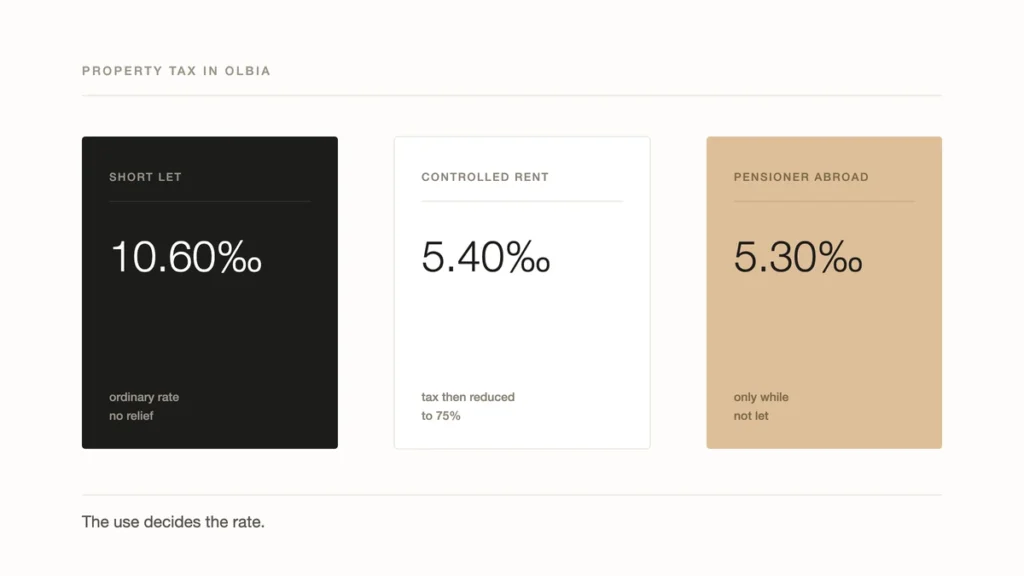
In short. IMU is Italy’s municipal property tax. You pay it because you own the property, not because you earn from it — an empty house pays exactly the same as a busy one. In Olbia a home let on short lets pays the ordinary rate of 10.60 per thousand, the highest in the schedule, because no reduced rate exists for holiday letting. And if you are a pensioner living abroad who currently enjoys the half rate, letting the property out cancels that relief. That last point costs more than most owners expect.
What IMU actually is
IMU — imposta municipale propria — is a tax on the possession of property, owed to the comune where the property sits. It has nothing to do with the rent you collect. You owe it whether the house is let all summer, let for two weeks, or stands empty for the whole year.
This is the single most useful thing to understand about it, and the one most often confused. The flat tax on your rental income — the cedolare secca — is a different tax, owed to a different authority, calculated on a different base. They do not replace one another and they do not offset one another. You pay both.
If the property were your main home, with your registered residence and habitual abode there, it would be exempt — except in the luxury categories A/1, A/8 and A/9. But a property you let to guests is, by definition, not your main home. It is a second home, and second homes pay.
The rates in Olbia for 2026
These come from the tax office’s published schedule, approved by municipal council resolution 104 of 9 December 2024.
| Type of property | Rate |
|---|---|
| Ordinary rate — this is what short lets pay | 10.60 ‰ |
| Main home, categories A/1, A/8, A/9, and one appurtenance each in C/2, C/6, C/7 | 4.00 ‰, with a €200 deduction |
| Property lent free of charge to a parent or child | 4.80 ‰, on a base reduced by 50% |
| Category A let on a canone concordato contract, excluding A/10 | 5.40 ‰, with the tax then reduced to 75% |
| Categories A/10, C/1, C/3 | 9.60 ‰ |
| Owned by non-residents meeting the conditions of art. 1(743), law 234/2021 | 5.30 ‰ |
| Category D | 7.60 ‰ |
| Building land | 9.60 ‰ |
Look at what is not in that list. There is no line for holiday lets, tourist lets or short lets. That is not an oversight: it means they fall into the ordinary rate, the residual one that catches everything without a specific treatment. In Olbia, the ordinary rate is the most expensive of the lot.
Why short lets get no relief
The reduced rates follow a housing policy, and seeing the logic makes it easier to stop expecting a discount that is not coming. Comuni reward the uses that meet the stable housing needs of the area: a canone concordato contract puts a home on the market at a controlled rent for residents; a free loan to a parent or child solves a family’s housing problem.
Holiday letting does not sit in that logic. From the council’s point of view it takes a unit out of the residential market rather than feeding it. In Olbia the treatment is simply the ordinary one — no surcharge, but no relief either.
How the tax is calculated
The arithmetic is mechanical. You need one number to start: the cadastral income (rendita catastale), which is on your visura catastale.
Taxable base = cadastral income × 1.05 × 160
Annual IMU = taxable base × rate
The 5% uplift is set by law, and the multiplier of 160 applies to residential categories in group A — excluding A/10 — and to appurtenances in C/2, C/6 and C/7.
| Step | Calculation | Result |
|---|---|---|
| Uplift | 800 × 1.05 | €840 |
| Taxable base | 840 × 160 | €134,400 |
| Annual IMU at 10.60‰ | 134,400 × 10.60‰ | €1,424.64 |
| Payment on account, 16 June | 50% | €712.32 |
| Balance, 16 December | 50% | €712.32 |
Those figures assume a cadastral income of €800, which is illustrative — yours will be different, and it is the only input that matters. Roughly €1,425 a year on a property that may work ten weeks of the season is a real weight on the net return, and it is fixed: it does not fall in a bad year.
Ownership shares and months both scale the bill. You pay in proportion to your share and to the months you held the property, and a month counts in full if you held it for at least fifteen days. In the year you buy, that matters: on the example above, completing on 10 September rather than 20 September is the difference between four months and three — about €118. Nobody will point that out to you spontaneously.
If you are a pensioner living abroad, read this part twice
Olbia’s schedule carries a rate of 5.30‰ — exactly half the ordinary one — for property owned by people not resident in Italy who meet the conditions of article 1(743) of law 234/2021.
The conditions, as the schedule states them for 2026: one single residential unit, held in Italy as owner or usufructuary, by someone drawing a pension under an international social security convention with Italy, resident in a state of insurance other than Italy. For that one property the tax is applied at half the ordinary rate.
And then the condition that undoes everything:
not let, and not lent for use.
So if you are retired, living abroad, drawing a pension under a convention with Italy, and you own a house at Olbia, Pittulongu or Porto Rotondo on which you currently pay the half rate — the moment you put it on the short-let market, the relief falls away. The property goes back to 10.60‰.
On the example above that is the difference between €712.32 and €1,424.64 a year. Over seven hundred euro of additional tax, every year, which has to come off the letting income before you can say whether letting is worth it at all. On a property that earns €9,000 a season, that is eight per cent of gross revenue, gone before any other cost.
We are not saying do not let it. We are saying do the subtraction first. This is the single most common miscalculation we see among foreign owners on this coast, and it is entirely avoidable — it is one line of arithmetic, done before the decision rather than after it.
To claim the relief in the first place you have to file an IMU declaration, by 30 June of the following year.
The other two reliefs you can lose
The same trap exists in two other forms, and both work the same way: the relief depends on a use that letting contradicts.
Free loan to a parent or child. The 4.80‰ rate with the base halved requires that the property be the comodatario‘s main home, with registered residence and habitual abode. The conditions are demanding even at the outset: lender and borrower must live in the same comune, the lender must own no other residential property in Italy beyond their own home and the one lent, luxury categories are excluded, the contract must be registered, and you cannot run two such loans. Put that house on the short-let market and the premise collapses, taking the relief with it.
Canone concordato. Ending a controlled-rent contract to switch to holiday letting loses both the 5.40‰ rate and the reduction of the tax to 75%. The return to the ordinary rate is immediate. Note also that the relief is not available simply because you let long-term: for contracts drawn up without the assistance of the landlord and tenant organisations, the comune requires a certificate of conformity issued by the bodies that signed the territorial agreement.
Across the three, the gap on the same property is wide. On our €800 cadastral income: €1,424.64 a year on short lets, €544.32 on a canone concordato contract, €322.56 on a free loan to a child. The difference between the first two is €880.32 a year, every year.
That comparison is not an argument for abandoning short lets — a well-run holiday let in Gallura earns what a controlled rent does not approach. It is an argument for comparing like with like. An owner who sets gross short-let revenue against the annual rent of a long let, without correcting for IMU, is comparing two numbers that are not comparable.
Deadlines, payment and the F24
| Instalment | Deadline in 2026 | Amount |
|---|---|---|
| On account | 16 June 2026 | 50% of the annual tax |
| Balance | 16 December 2026 | 50%, adjusted for any changes |
Payment is made on the F24 form, section EL, with Olbia’s municipal code G015. The tax code to use for a second home on short lets — and for its garage and cellar — is 3918, “other buildings”. The others are 3912 for a main home in the luxury categories, 3916 for building land and 3925 for the state share on group D property.
If the annual amount due is under €12, no payment is required.
Miss a deadline and the route back is ravvedimento operoso: you pay the tax, a reduced penalty and interest calculated day by day, with the penalty rising the longer you wait. It stops being available once the comune has served an assessment — which is to say, it works as long as you are the one who notices first. Two reminders in the calendar, around 10 June and 10 December, are enough.
Claiming a reduced rate
To benefit from any reduced rate you must file a communication with the comune, on its own form, by 30 June of the following year. It then holds good for later years too, provided nothing changes that alters the tax due.
That proviso is where the disputes come from. Change the use of the property and fail to tell the comune, and you carry on paying at the reduced rate while no longer entitled to it. The debt builds quietly, and the first cross-check brings an assessment with penalties and interest. The comune holds the tourist tax portal data and the cadastral records: a property declaring guest nights while paying IMU at the free-loan rate is not a hard anomaly to spot.
Five mistakes worth avoiding
- Using last year’s rate. Rates are set by council resolution and can change. Checking the current schedule before each instalment costs five minutes.
- Forgetting the appurtenances. Garage, cellar and parking space have their own cadastral incomes. If the property is not your main home, they carry no exemption — they are simply added in.
- Not updating the communication when the use changes. The most expensive of the five, because the liability accrues in silence.
- Confusing IMU with income tax. IMU is municipal and taxes ownership. The cedolare secca is national and taxes income. You pay both.
- Leaving IMU out of the yield calculation. A property taking €12,000 gross and paying €1,400 of IMU has lost nearly 12% of turnover before any other cost.
Frequently asked questions
How much IMU is payable on a short-let property in Olbia?
The ordinary rate of 10.60 per thousand applies, calculated on the cadastral income uplifted by 5% and multiplied by 160. On a cadastral income of €800 that is about €1,425 a year.
Is there any IMU relief for short lets?
No. Olbia’s schedule contains no reduced rate for holiday or short letting, so they fall into the ordinary rate, which is the highest. Reliefs exist for controlled-rent contracts and for property lent free to a parent or child, and both are incompatible with holiday letting.
Do I pay IMU if the property stays empty?
Yes. IMU is a tax on ownership, not on income. It is due whether the property is let, empty or used by you — which is precisely what makes it a fixed cost to plan for.
I am a pensioner living abroad. Do I lose the relief if I let the property?
Yes. The half rate of 5.30‰ under article 1(743) of law 234/2021 requires the single residential unit to be neither let nor lent for use. Put it on the market and it returns to the ordinary 10.60‰ — on our worked example, a difference of over €700 a year.
When is IMU paid?
In two instalments: on account by 16 June and the balance by 16 December. A missed payment can be regularised through ravvedimento operoso, with a penalty that grows the longer you leave it.
Which F24 code do I use?
For a second home on short lets, and for its garage and cellar, the code is 3918 — “other buildings” — in section EL, with Olbia’s municipal code G015. No payment is due if the annual amount is below €12.
Does IMU replace the tax on my rental income?
No. They are separate and cumulative. IMU is municipal and falls on ownership; the cedolare secca or ordinary income tax is national and falls on the income the property produces. Neither excludes the other.
Do I pay IMU on the garage and the cellar too?
Yes, if the property is not your main home. Appurtenances have their own cadastral income and are calculated with the same multiplier, added to the overall base.
The short version
IMU is the most predictable cost in a holiday let and the least discussed. Predictable because you know it a year ahead and it does not depend on how the season goes; undiscussed because it arrives in two quiet instalments while your attention is on bookings.
Three things to take away. Short lets in Olbia pay the full 10.60‰, with no relief of any kind. The gap against the reduced regimes is wide — up to €880 a year on the same house. And changing the use of a property cancels the reliefs attached to the old use, the pensioner’s half rate above all: if you do not tell the comune, the liability accrues in silence until someone cross-checks.
Own a property in Olbia? AirAffitti runs the operational side of short-term letting — listings and pricing, guest communication, check-in coordination, cleaning between stays, and the day-to-day administrative workflow that comes with stays. What our management covers sets out the detail, and if you want the arithmetic before the decision, we can put the figures for your property side by side.
What we are not is a tax adviser or an accountant, and nothing here is tax advice. The amounts above are worked on an illustrative cadastral income; your own bill depends on your property’s cadastral income, your share and your months of ownership. Check the current schedule on the comune’s website before each payment, and take advice from a qualified Italian accountant.
Sources
- Comune di Olbia, Settore Finanze e Personale — Ufficio Tributi, Imposta Municipale Propria (IMU) 2026, form 54.57/2026, updated 15 April 2026, municipal council resolution 104 of 9 December 2024 — rates, conditions for each relief, deadlines, F24 codes and the €12 threshold.
- Law 234/2021, article 1(743) — the half rate for non-resident pensioners, and the condition that the property be neither let nor lent.
- Law 160/2019, article 1(747)(c) — the free-loan relief.
This guide is for information only and reflects the schedule in force on the date of publication. It is not tax advice.