Property Owners
Short-Term Rental Tax in Italy: Cedolare Secca or IRPEF?
Italy taxes short-let income at 26%, or 21% on one property you nominate each year. What the platform withholds, and the new two-property limit.
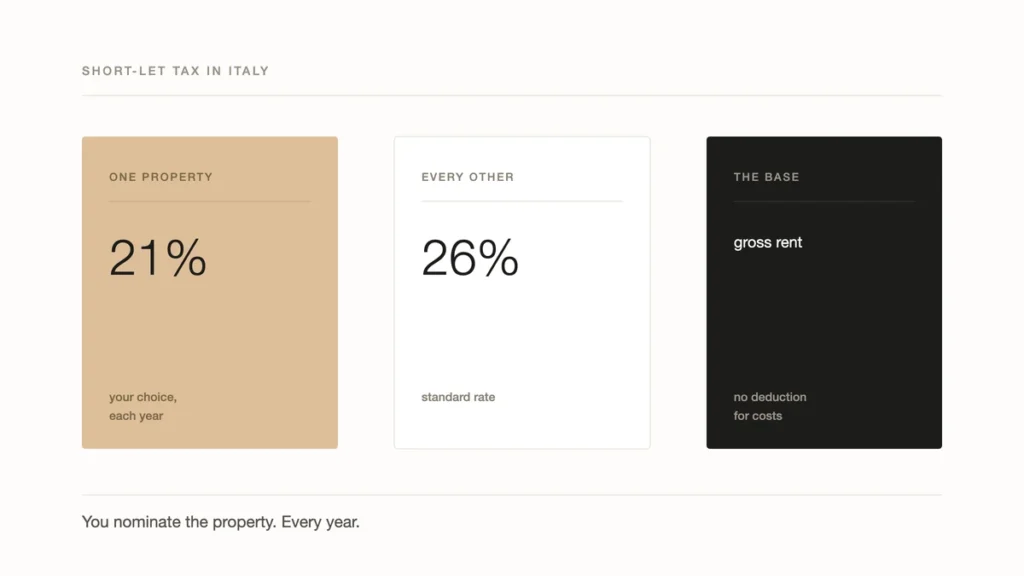
In short. Income from short lets in Italy can be taxed in two ways: the ordinary income tax bands, or a flat substitute tax called cedolare secca. The flat rate is 26%, reduced to 21% on one property of your choosing each year. The flat tax is calculated on the gross rent, with no deduction for costs. If a platform collects the money it withholds 21%, but that withholding never settles the bill on its own. And from 2026 the regime only applies if you put no more than two properties into short lets in the same tax year.
What the cedolare secca actually is
It is a substitute tax. Choose it and the rental income is taxed at a single flat percentage instead of going into your ordinary income tax calculation: no IRPEF on those earnings, no regional or municipal surcharges on them either. You pay the percentage and that income is done.
It applies to short lets — residential property in Italy, let for no more than 30 days per contract, by individuals outside of business activity. No particular form of contract is required.
The trade-off is that it is calculated on the gross rent, with no deduction for costs. Cleaning, laundry, utilities, the agency’s commission, the new mattress: none of it reduces the base. For most owners the flat rate still wins, but if you have a year of heavy documented expenses and little other income, the ordinary route can come out ahead. That is an arithmetic question, not a matter of principle, and it is worth asking your accountant to run both.
The two rates, and why the second one matters
Since 1 January 2024 there are two rates, and the way they combine is the part most summaries get wrong.
- The standard rate is 26%.
- It drops to 21% for income from short-let contracts on one property per tax year, chosen by you.
Read that second line carefully, because the common misreading is expensive. The 21% does not belong to the first property you ever let, nor to the one you have had longest, nor to your main home. It belongs to whichever single property you nominate, and you nominate it in the tax return for that year. One property gets 21%; everything else gets 26%.
Which property should get the 21%?
The one that earns the most. The five-point gap applies to whatever base you attach it to, so you want it attached to the largest base.
If you let two flats and one takes €22,000 a year while the other takes €8,000, putting the 21% on the larger one rather than the smaller saves five per cent of the €14,000 difference — €700, for ticking a different box. It is not a renovation, it is a line in a form, but it has to be looked at before the return is filed rather than after.
Two things follow from this. First, the decision is made again every year, and it should be: if you have just put a property on the market with dynamic pricing and you expect it to overtake the other, the nomination should follow the money. Second, what counts is what each property actually earned in that tax year, not its history or its potential.
Cedolare secca or ordinary income tax?
| Cedolare secca | Ordinary income tax (IRPEF) | |
|---|---|---|
| Rate | 26%, reduced to 21% on one property you nominate | Progressive bands, from 23% upwards |
| Deduction for costs | None | A flat 5% reduction of the rent |
| Regional and municipal surcharges | Not applied to this income | Applied |
| Typically better for | Owners with other income and few deductible costs | Owners whose total income sits in the lowest band |
The flat 5% reduction in the right-hand column is worth noting precisely because it does not exist on the left. Under ordinary taxation the taxable amount is 95% of the rent; under the cedolare secca it is 100%. That is part of the trade for the flat rate.
A worked example, with round numbers. On €15,000 of rent taxed at 21%, the flat tax is €3,150. Under ordinary taxation, for someone whose other income already puts this slice in the 35% band, the same €15,000 would be taxed on €14,250 after the 5% reduction — roughly €4,990, before surcharges. For an owner with a salary or a pension behind them, the flat rate usually wins, and it wins by more than people expect.
What the platform withholds, and what it leaves you
When an agency or an online platform collects the guest’s payment, it acts as a withholding agent: it takes 21% of the gross amount and pays it to the Italian tax authorities in your name. Two misunderstandings grow out of this, and both cost money.
Withheld does not mean settled. Since 2024 that 21% is always withheld on account, whatever regime you have chosen. The platform does not know, and does not try to know, which rate applies to you. If your property falls under the 26% rate, the difference is yours to pay when you file. If you were owed something back, you reclaim it the same way.
Withheld does not mean declared. The rent still has to appear in your Italian tax return. The withholding is then set against the tax due — it is a credit, not a substitute for the filing. The intermediary issues you a certificate showing the gross amounts and the tax withheld, and that document is where your accountant starts.
And if you also let directly — a bank transfer, your own website, a repeat guest who books by email — there is no withholding at all on those bookings. The whole of the tax on that income is yours to calculate and pay.
One habit worth breaking early: adding up what lands in your bank account and calling it your turnover. What lands is already net of the platform’s commission and net of the 21% withheld. The taxable base is the gross rent, and it is always larger than the figure you see on your statement.
The two-property limit from 2026
This is the change most likely to catch an existing owner out.
The short-let tax regime now applies only if you put no more than two properties into short lets in a given tax year. Until 31 December 2025 the limit was four. The change was made by the 2026 budget law — law 199/2025, article 1 paragraph 17 — and it takes effect from the 2026 tax year.
Above that threshold, the law presumes the activity is being carried on as a business, by whoever is carrying it on. That is not a small administrative difference: it means VAT registration and the accounting obligations that come with running a business, and the cedolare secca is no longer available.
Two details decide whether this affects you. The count looks at properties put into short lets during the tax year, not properties you own — a house you keep for your own use does not enter the count. And the limit is assessed per taxpayer, so where a property is jointly owned, each owner’s position is counted separately.
If you went into 2025 comfortable with three or four flats, you are not comfortable in 2026. That is worth a conversation with an accountant before the season rather than after it.
If you are not resident in Italy
Here the honest answer matters more than a tidy one.
Rental income from property located in Italy is taxable in Italy, regardless of where you live. That much is settled. You will need an Italian tax code — the codice fiscale — which you will already have if you bought the property, and you will need to file an Italian return for that income.
Whether a non-resident owner can opt for the cedolare secca is a question we are not going to answer for you. The legislation setting up the flat tax does not state a residence requirement for the landlord, and in practice non-resident owners are widely understood to be able to use it. But the Revenue Agency’s own guidance on short lets addresses non-residents only in their capacity as intermediaries, not as landlords, and we found no official statement covering your case directly. Ask an Italian accountant, and get the answer in writing before you file.
What we can set out is the practical sequence, which does not change either way:
- Have the property properly registered, with the codes that go with it — our guide to the CIN and IUN in Sardinia covers that.
- Keep the gross figures, not the net ones. Platform statements show what you received; you are taxed on what the guest paid.
- Collect the withholding certificate from every intermediary that collected money for you.
- Track direct bookings separately — nothing has been withheld on those.
- File the Italian return, nominate the property that takes the 21%, and set the withholdings against the tax due.
- Keep the records. The assessment window is long and the documents are the defence.
For the mechanics of accessing Italian tax portals from abroad, including the route for people without a digital identity, our guide to the tourist tax in Olbia sets out the Revenue Agency’s published procedure for foreign individuals.
What this tax is not
Three obligations get confused with each other constantly, and keeping them apart saves a great deal of trouble.
The tourist tax is not this. It is a municipal tax paid by the guest, which you collect and pay over to the comune — separate rules, separate deadlines, separate portal. In Olbia it is charged per person per night. That guide is here.
The CIN is not a tax at all. It is an identification code, issued through the Ministry of Tourism’s database, to be displayed at the property and quoted in every listing. Without it a listing is irregular. It has nothing to do with what you pay and everything to do with whether you can advertise.
Registering your guests is a third thing again, owed to the police through Alloggiati Web and, in Sardinia, SIRED. No platform does any of these three for you.
Practical checklist
- Decide, each year, which property takes the 21% — the one that earned the most.
- Count the properties you are putting into short lets: more than two in 2026 changes your position entirely.
- Work from gross rent, not from what reaches your account.
- Collect a withholding certificate from every intermediary.
- Keep direct bookings in a separate column — no tax has been withheld on them.
- Declare everything, including income already withheld at source.
- Keep the tourist tax, the CIN and the police registration in their own boxes.
Frequently asked questions
What is the cedolare secca?
A flat substitute tax on rental income. Instead of adding the rent to your other income and taxing it at progressive rates, you pay a single percentage on it and that income is settled, with no regional or municipal surcharges applied to it.
Is the rate 21% or 26%?
Both. Since 2024 the standard rate is 26%, reduced to 21% for one property per tax year, chosen by you and nominated in your tax return. The 21% is not automatically attached to any particular property.
Can I change which property gets the 21% each year?
Yes. The nomination is made in the return and applies to that tax year only. The following year you can move it to whichever property earned the most, with no further formality.
Does Airbnb’s withholding settle my tax?
No. The 21% a platform withholds is always on account, whatever regime you use. If your property is taxed at 26% you pay the difference when you file, and the rent must be declared regardless.
Are my costs deductible under the flat tax?
No. The cedolare secca is calculated on the gross rent with no deduction for costs. Ordinary taxation allows a flat 5% reduction of the rent instead, which is one of the things to weigh when comparing the two.
How many properties can I let under this regime?
From 2026, no more than two in the same tax year, under law 199/2025. Until the end of 2025 the limit was four. Above the threshold the activity is presumed to be a business, with VAT registration and the obligations that follow.
Does a property I keep for myself count towards the limit?
No. The count looks at properties actually put into short lets during the tax year, not at everything you own. The limit is also assessed per taxpayer, so joint owners are counted separately.
Can I use the cedolare secca if I live abroad?
Income from Italian property is taxable in Italy wherever you live, and you will need an Italian tax code and an Italian return. On whether a non-resident landlord may opt for the flat tax, the Revenue Agency’s published guidance on short lets does not address the case directly, so take advice from an Italian accountant rather than an answer from a guide.
Is the tourist tax part of this?
No. The tourist tax is a separate municipal charge paid by the guest and collected by you, with its own portal and deadlines.
The short version
Two rates, one nomination made fresh every year, a base that is gross rather than net, a platform withholding that is an instalment rather than a conclusion, and from 2026 a ceiling of two properties. Get those five things right and the Italian short-let tax is manageable. Get the nomination wrong and you pay five per cent more than you needed to on your best-earning property; miscount the properties and you are in an entirely different regime without having noticed.
Own a property in Olbia? AirAffitti runs the operational side of short-term letting — listings and pricing, guest communication, check-in coordination, cleaning between stays, and the day-to-day administrative workflow that comes with stays, including keeping the gross figures and the platform certificates in order for whoever prepares your return. What our management covers sets out the detail.
What we are not is a tax adviser or an accountant, and nothing here is tax advice. Rates, thresholds and rules change, sometimes in the budget law each December. For your own position, speak to a qualified Italian accountant.
Sources
- Agenzia delle Entrate, Locazioni brevi: la disciplina fiscale e le regole per gli intermediari, April 2026 edition — rates, nomination of the property taxed at 21%, gross base, nature of the withholding, and the two-property limit.
- Law 199/2025 (2026 budget law), article 1 paragraph 17 — reduction of the limit from four properties to two, from the 2026 tax year.
- Law 213/2023 (2024 budget law) — introduction of the 26% rate and of the withholding always being on account.
- Decree-Law 50/2017, article 4 — the short-let regime and the obligations of intermediaries.
- Legislative Decree 23/2011, article 3 — the cedolare secca.
This guide is for information only and reflects the rules in force on the date of publication. It is not tax advice. For your own property and your own circumstances, consult a qualified Italian accountant.