Property Owners
CIN and IUN in Sardinia: A Guide for Owners
Two codes, not one: the regional IUN comes first, the national CIN is built on it. The order, the 30-day deadline, and the login problem non-residents hit.
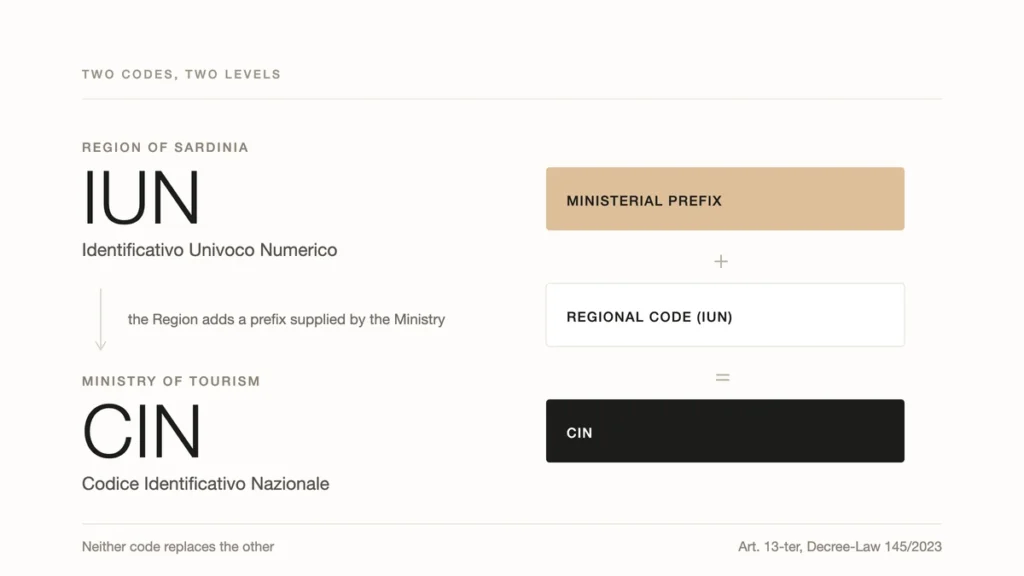
If you let a property in Sardinia for short stays, you need two codes, not one. The IUN is regional, issued by the Sardinian Region. The CIN is national, issued by the Ministry of Tourism. They are not alternatives and neither replaces the other: in Sardinia the IUN comes first, and the CIN is built on top of it. The order is fixed, the national deadline is 30 days from the IUN, and both codes are free. The part that catches out non-resident owners is not the paperwork but the login.
Last checked: 5 October 2026. These rules change. Before acting, check the official sources linked throughout this guide.
Two codes, two levels of government
Italy has a national register of accommodation and short-let properties, the Banca Dati Strutture Ricettive (BDSR), run by the Ministry of Tourism. Every property in it carries a CIN, a national identification code, introduced by article 13-ter of Decree-Law 145/2023, converted with amendments by Law 191/2023.
Sardinia, like several Italian regions, already ran its own register before the national one existed. Its code is the IUN, Identificativo Univoco Numerico, assigned by the regional Department of Tourism.
The national law anticipated exactly this situation. Where a region already assigns its own codes, article 13-ter requires that region to recode them as CIN by adding an alphanumeric prefix supplied by the Ministry, and to transmit them to the national database. In other words the CIN is not a separate, parallel number you obtain in isolation: in Sardinia it is built on the regional one.
What is the IUN?
The IUN is Sardinia’s own identifier for accommodation, including private homes let occasionally to tourists. For short lets it is granted under article 21-bis of Regional Law 16/2017, which governs locazione occasionale a fini ricettivi — occasional letting for tourist purposes.
Article 21-bis sets two obligations that sit underneath the code itself:
- letting is permitted only after notifying the Comune where the property is, stating the period of availability, and in any case at the point the property goes onto an online booking portal;
- the owner must send guest movement data to the regional tourism department for statistical purposes, and make the public-security notifications required by the TULPS.
Since 1 February 2025, applications for short lets are accepted only through the regional RLO platform, the Registro Locazioni Occasionali. The Region states plainly that requests arriving by email, certified email or on paper are rejected.
One distinction worth holding onto, because it changes which door you knock on. Properties that are accommodation businesses under Regional Law 16/2017 — hotels, B&Bs, campsites, holiday-home businesses — are started through SUAPE, the one-stop business desk, and the IUN is then issued automatically. A private home let occasionally goes through RLO instead. Most foreign owners with a second home are in the second group.
What is the CIN?
The CIN is the national code. It applies to residential units let for tourist purposes, to short lets under article 4 of Decree-Law 50/2017, and to hotel and non-hotel accommodation businesses. It has been compulsory since 1 January 2025.
There is no threshold below which it stops applying. Not a number of nights, not a level of income, not “only in August”. The law speaks of a residential unit or a portion of it, so letting a single room is inside the obligation too.
The CIN is free. It is obtained through the BDSR portal, and the Ministry’s own manual confirms that the person who applies can be the owner, the manager or a delegate.
IUN and CIN side by side
| IUN | CIN | |
|---|---|---|
| Level | Regional | National |
| Issued by | Sardinian Region, Department of Tourism | Ministry of Tourism |
| Legal basis | Regional Law 16/2017, art. 21-bis for occasional lets | Art. 13-ter, Decree-Law 145/2023 (Law 191/2023) |
| Where it applies | Sardinia only | All of Italy |
| How you get it | RLO platform, after notifying the Comune | BDSR portal, after the IUN exists |
| Comes first? | Yes | No — it is built on the regional code |
| Cost | Free | Free |
Does the CIN replace the IUN?
No. This is the single most common misunderstanding, and it is worth being precise rather than reassuring.
The national law does not abolish regional codes. It takes them as the base and layers the national code on top, by prefix. The regional obligations attached to the IUN — the notification to the Comune, the guest-data reporting — continue to exist on their own terms, and they are enforced by the Region under its own sanctions.
So a Sardinian short-let property that is in order has both: an IUN from the Region and a CIN from the Ministry.
The order, which is not negotiable
Trying to obtain the CIN first is the mistake that costs foreign owners the most time, because the national database will not find a property the Region has not yet transmitted.
- Notify the Comune. State the period for which the property will be available. This is the precondition for everything else.
- File the declaration on RLO. The regional platform for occasional lets.
- The Region processes it and assigns the IUN, together with credentials for SIRED / ROSS 1000, the system used to report guest movements for statistical purposes.
- Wait 24 hours. The Region is explicit about this: do not log in to the national database before then, because the regional data will not be there yet.
- Apply for the CIN on the BDSR. You confirm the data the Region has already supplied — fields on a grey background come from the Region and cannot be edited nationally — and complete what is missing.
If your property does not appear in the BDSR, the national manual provides a “missing property” report. It goes to the Region for checking. If the Region has not closed the report within 30 days, you can request and receive a CIN in unverified status, which later becomes verified once the Region completes its checks.
How long you have
The Sardinian Region states it directly: you have 30 days from the date the IUN is assigned to apply for the CIN, and after that you are exposed to a penalty.
The underlying national rule is more conditional than that sentence suggests, and the difference matters if you ever have to argue a case. Article 13-ter puts the duty to recode and transmit on the Region, within seven days of assigning its own code. The owner files directly with the Ministry in defined situations — among them, when the region has not recoded and transmitted — and it is there that the thirty-day term sits.
Practically, treat the Region’s version as your deadline: thirty days from the IUN. It is the stricter reading and the one the authority responsible for you has published.
Where the codes have to appear
The national obligation has two separate limbs, and both are explicit in the law:
- Display the CIN outside the building in which the property sits, respecting any planning and landscape constraints — not a theoretical caveat in a listed centre or along the Costa Smeralda;
- state the CIN in every advertisement, wherever published and communicated. That means Airbnb, Booking.com, your own website, property portals, and print.
On the physical display, the Sardinian Region adds two useful points. The metal plaques used by accommodation businesses under Regional Law 16/2017 may not be used by properties let under short-let or tourist-letting contracts. And because the Ministry has issued no specification for the format or size of the CIN display, the method is free — so the Region suggests checking with your Comune whether it has set local rules.
If you already list on Airbnb or Booking.com
The obligation is not only yours. Estate agents and the operators of booking portals are themselves required to show the CIN in the adverts they publish.
That is why an advert without a code is not simply a quiet irregularity. The penalty for failing to display or state the CIN comes with the immediate removal of the irregular advert. In July, on the Olbia coast, a removed listing costs considerably more than the fine attached to it.
The obstacle nobody warns a non-resident about
The forms are not the hard part. The login is.
Italian public portals authenticate through national digital identity: SPID, the public digital identity system, or CIE, the electronic identity card. Both assume an Italian identity document or an Italian-issued credential. An owner living in Manchester, Munich or Rotterdam frequently has neither.
There is a route, and it is official. For the national database, the Ministry of Tourism’s own operator manual sets out a dedicated accreditation procedure for foreign citizens who are owners, managers or delegates: you register through a form on the BDSR, and the Ministry issues a username and password by email, with two-factor authentication configured through an authenticator app. The manual is explicit that registration is not instant, because Ministry staff verify it first, and that the accreditation is strictly personal.
The regional side has a published route too, and it is the simpler of the two. Owners whose residence or registered office is abroad — private individuals and companies alike — are not required to use the RLO platform at all. The Region asks them to send the request to a dedicated address, tur.iunrelease@regione.sardegna.it, attaching the forms it publishes for foreign private owners and for foreign companies: one for the notification to the Comune, one for the IUN and ROSS 1000 access. If you hold neither SPID nor CIE, that is the door to use — and it is worth doing before you plan a season, not after.
The safety requirements in the same law
Article 13-ter does not stop at codes, and the part most often missed carries its own penalty.
Every unit let for tourist purposes or as a short let — in business form or not — must have working detectors for combustible gas and carbon monoxide and portable fire extinguishers compliant with the law. The law also says where: in accessible, visible positions, particularly near entrances and near the areas of greatest risk, and one extinguisher per 200 square metres of floor area or part thereof, with a minimum of one per floor.
For a two-room flat in Olbia that means one extinguisher. A real one, serviced, and reachable — not shut in a cupboard.
Where the letting is carried on in business form, the plant-safety requirements of national and regional law apply on top.
What it costs to get it wrong
The penalties are in the law itself, and they are per property:
| Breach | Penalty |
|---|---|
| Offering or letting a unit without a CIN | €800 to €8,000, according to the size of the property |
| Not displaying or stating the CIN | €500 to €5,000 per property, plus immediate removal of the advert |
| Missing detectors or extinguishers | €600 to €6,000 for each breach established |
| Letting in business form without the SCIA | €2,000 to €10,000 |
Two things shape how this actually works. First, the national penalties do not apply where the same conduct is already penalised by regional law — and Sardinia has its own, from €200 to €1,000, for an operator who fails the notification duties under article 21-bis. Second, enforcement sits with the Comune, through its local police, and the results of checks are also passed to the local office of the Revenue Agency.
That last detail is the one to take seriously. The Revenue Agency and the Guardia di Finanza are required by the same law to run risk analyses aimed specifically at identifying properties let without a CIN. The code is not only a tourism formality; it is a tax trail.
A checklist before you let
| Step | Where | Done when |
|---|---|---|
| Sort out digital identity, or who will file for you | — | Before anything else |
| Notify the Comune, with the period of availability | Your Comune | Before listing anywhere |
| File the declaration for the IUN | RLO platform | Submitted and accepted |
| Receive the IUN and the SIRED / ROSS 1000 credentials | By email from the Region | Both received |
| Wait 24 hours after the IUN | — | The Region says not to log in earlier |
| Apply for the CIN | BDSR portal | Within 30 days of the IUN |
| Display the CIN outside the building | The property | Check local rules with the Comune |
| Add the CIN to every listing | Airbnb, Booking.com, your site | Before the first booking |
| Fit gas and CO detectors and extinguishers | The property | One per 200 m², minimum one per floor |
| Set up guest reporting | Police and SIRED / ROSS 1000 | Before the first guest |
Frequently asked questions
What is an IUN in Sardinia?
It is the Identificativo Univoco Numerico, the identification code the Sardinian Region assigns to accommodation, including private homes let occasionally to tourists under article 21-bis of Regional Law 16/2017. For short lets it is obtained through the regional RLO platform, after notifying the Comune.
What is a CIN in Italy?
The Codice Identificativo Nazionale, the national code introduced by article 13-ter of Decree-Law 145/2023 and compulsory since 1 January 2025. It is issued by the Ministry of Tourism through the national accommodation database, and the procedure set out in the Ministry’s manual involves no payment.
Do I need both the IUN and the CIN in Sardinia?
Yes. They operate at different levels and neither replaces the other. In Sardinia the IUN comes first, and the national law requires the Region to recode its own codes into CINs by adding a prefix supplied by the Ministry.
Does the CIN replace the IUN?
No. The national code is layered on the regional one rather than substituting it, and the regional obligations attached to the IUN continue to apply under the Region’s own rules and penalties.
Can a foreign owner get a CIN without SPID?
Yes, for the national database. The Ministry of Tourism’s operator manual sets out an accreditation procedure for foreign citizens, with a username and password issued by email after the Ministry verifies the registration, and two-factor authentication through an authenticator app. It is not instant. On the regional side you do not need one: owners resident or registered abroad are exempt from the RLO platform and send their request to the Region by email, using the forms it publishes for foreign owners.
Can I list on Airbnb or Booking.com without a CIN?
No. The code must appear in every advertisement wherever published, and portals and agents are themselves obliged to show it. The penalty for not displaying it includes the immediate removal of the advert.
How long do I have to get the CIN after the IUN?
The Sardinian Region states 30 days from the date the IUN is assigned, after which you are exposed to a penalty.
Where this leaves you
None of this is difficult in itself. It becomes expensive because the steps run in a fixed order, each one waits on the one before, and a foreign owner usually discovers the digital-identity problem at the point when the season has already started.
Own a property in north-east Sardinia? Once it is ready to be let, AirAffitti can help you organise and run the operational side: listings, guest communication, pricing, check-in, cleaning between stays and the day-to-day management of apartments and rooms in Olbia, Porto Rotondo and along the coast. What our management covers sets out what is included.
What we are not is a law firm or a tax practice. Nothing on this page is legal or tax advice. For your own position — whether your letting is occasional or a business, which thresholds you are near, how it is taxed — the official sources linked above and a qualified Italian lawyer or accountant are the right places to go.
AirAffitti editorial team