Property Owners
Short Lets in Porto Rotondo: How the Market Works
Porto Rotondo is in the Comune di Olbia, not the Costa Smeralda. What that changes for your obligations, your pricing and your season.
In short. Porto Rotondo is not the Costa Smeralda, and the difference is not one of prestige. It is a purpose-built village inside the Comune di Olbia, which means the tourist tax, the municipal rules and the notifications you owe are Olbia’s — not Arzachena’s. It also means that walking distance to the piazzetta and the beach is a sharper market variable here than almost anywhere else on this coast. This guide covers what the market actually rewards, what the season really looks like, and the one place to check values that is not trying to sell you something.
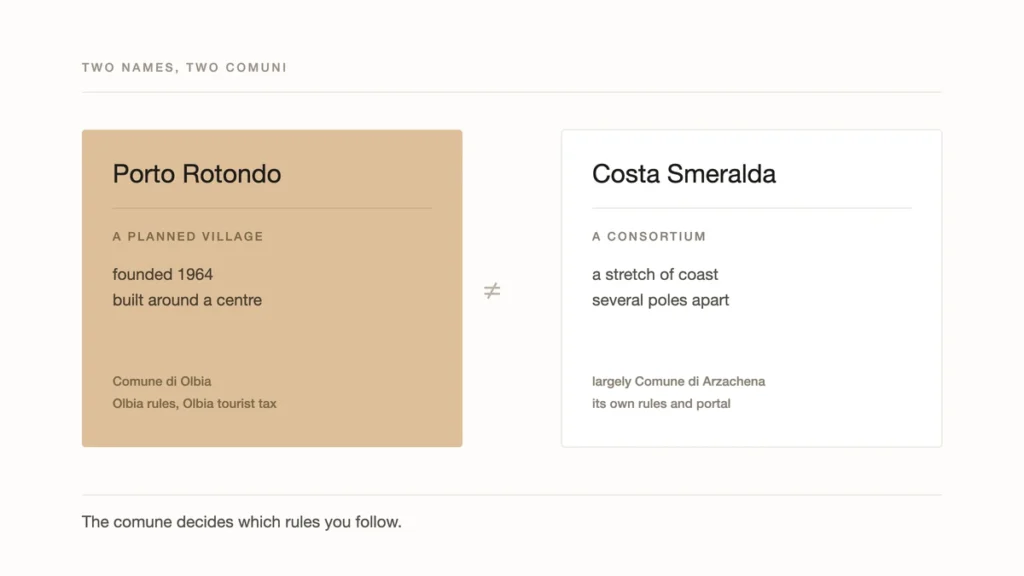
Porto Rotondo is not the Costa Smeralda
The two get used interchangeably in English-language property listings, and foreign owners inherit the confusion. It is worth undoing, because it has administrative consequences.
A designed village, not a stretch of coast
Porto Rotondo was founded in 1964, on the initiative of the Venetian brothers Nicolò and Luigi Donà dalle Rose, on land bought from Vittorio Cini. The development today covers roughly 500 hectares between the gulfs of Cugnana and Marinella, around a marina of several hundred berths — the Consorzio di Portorotondo puts it at about 700.
The Costa Smeralda is a different kind of thing: a consortium created to govern the development of a stretch of coastline in the comune of Arzachena, with life spread across several poles some distance apart. Porto Rotondo was drawn as a small town — a square, a church, an open-air theatre, a marina — with villas and residences grown around it.
The consequence is immediate and commercial. In a place built around a centre, how far you are from that centre on foot is a market variable, not a detail. A property ten minutes’ walk from the piazzetta and one five minutes away by car are not in the same competition, even though both read as “Porto Rotondo” on a listing.
Why the administrative line changes your obligations
Porto Rotondo is a district of the Comune di Olbia. So the tourist tax, the regulation to read, the prior notification of tourist letting and the local charges are Olbia’s.
Owners who believe they are “in the Costa Smeralda” sometimes look for their information on the wrong comune’s website, and find out when the payment portal does not recognise the property. If you are buying or letting here, that is the first thing to get right, and it is free to get right.
Who actually stays in Porto Rotondo
The guest here is not the guest in Olbia town, and pricing a property as though they were the same is the most common way to lose a season.
It is a destination audience. People come for the place itself — the marina, the square, the beaches around it — and they come when the place is at its best. They tend to book further ahead than city guests, to stay in longer blocks, and to expect the property to be ready rather than adequate. A fault that a business traveller in town would shrug at is, here, the difference between a good review and a bad one.
Two formats dominate, and they behave differently. An apartment or a unit in a residence works on couples and small families, with a shorter, sharper peak and fixed costs spread over relatively few nights. A detached villa works on groups and extended families, with far higher revenue per night, an even more concentrated season, and a real requirement for someone on the ground looking after the garden, the pool and the installations.
The season, and how to estimate it honestly
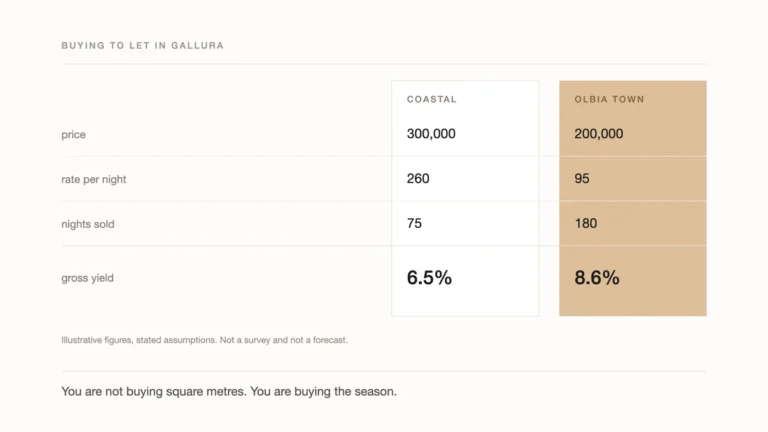
This is where projections go wrong, and the error is always the same: taking a high nightly rate and multiplying it by far too many nights.
The right denominator is the nights you can actually sell, not the nights in the year and not the nights in the summer. Build the estimate in bands — a short peak, the shoulders around it, and the rest — and give each band its own rate and its own realistic number of nights. Then take out the weeks you intend to keep for yourself, and take out the gaps: if you work on weekly stays with Saturday changeovers, the two- and three-night holes midweek often go unsold, and they belong in the model as unsold.
Higher revenue per night also means higher operational risk: noise in a residential village, guests who were not the ones who booked, and wear that accumulates faster than in a property let fifty nights a year. None of that is a reason not to let here. It is a reason to run it properly.
Our guide to what a holiday rental in Olbia earns sets out the method in more detail, including why the shoulder months decide more than August does.
What a property is worth: one place to look
A great many pages about Porto Rotondo publish prices per square metre and expected yields. Most are commercial material produced by parties with an interest in the transaction. They are not a basis for a valuation.
The public, impartial reference is the OMI property quotations published by the Agenzia delle Entrate, Italy’s revenue agency. For Porto Rotondo:
- Open the OMI quotations consultation service.
- Select the most recent half-year, province of Sassari, comune of Olbia.
- Identify the OMI zone that covers Porto Rotondo — the development does not coincide with the centre of Olbia, so check the perimeter on the mapping service.
- Read the minimum–maximum range for the property type (civil dwellings, villas and small villas) and the state of repair that matches.
Three warnings, and they matter more here than elsewhere. It is a range, not a price, and in Porto Rotondo position within the development moves the value a great deal. It is half-yearly and retrospective: it photographs the past. And it concerns sale values, not income — the two estimates are made separately and one does not imply the other.
If you are buying rather than already owning, the checklist in our guide to buying a property in Olbia to rent out is the one to use before signing.
What a property needs to work here
The expectations are set by the destination, not by your budget. In practice that means outdoor space that is genuinely usable, because here it is the main room from June onwards; air conditioning that works in every bedroom; a kitchen equipped for people who will cook for six; reliable connectivity, because the family that stays three weeks includes someone working; and a standard of linen, crockery and finish that matches what the guest paid.
Parking deserves its own line. In high season it is a scarce commodity in the village, and a dedicated, clearly explained space is a real differentiator rather than a nice-to-have.
Two things are worth more than any amenity: photographs that show the walk — what you actually see on the way to the square or the beach — and an honest description of the distance. An owner who overstates proximity gets the booking and then the review.
The practical constraints people discover late
In a planned development with shared infrastructure, there are costs and rules that do not exist in an ordinary block of flats.
Consortium contributions can be substantial and recur every year, whether the property is let or not. Establish the amount before you buy, and put it in the model as a fixed cost.
Building and estate rules may constrain what you can change outside, from shading to fixtures to the garden. And where the property is in a condominium, the condominium regulation may restrict or prohibit tourist letting outright — read it in full before completion, not after, because if it is contractual in nature and forbids the activity, the plan does not survive it.
Access and services follow the season. A village built around summer does not offer the same services in February, which affects both what you can promise a guest and what it costs you to keep the property maintained out of season.
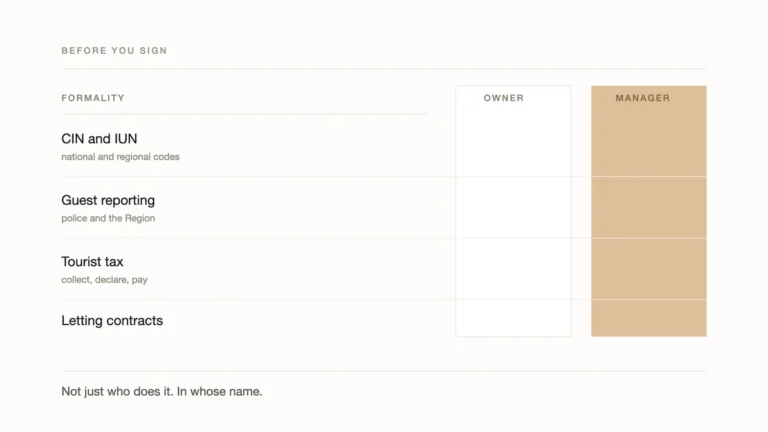
What you owe, and to whom
Everything here runs through Olbia and through the Sardinian Region. The full detail is in the dedicated guides; this is the map.
| Obligation | Where | When |
|---|---|---|
| IUN, the regional code | Sardinian Region, after notifying the Comune of Olbia | Before letting |
| CIN, the national code | Ministry of Tourism, BDSR | After the IUN; to be displayed and quoted in every listing |
| Guest identification and reporting | Alloggiati Web, police | Within 24 hours of arrival, 6 if the stay is shorter |
| Guest movement data | SIRED / Ross1000, regional portal | Within 24 hours, including nil returns |
| Tourist tax | Comune di Olbia portal, via PagoPA | At the deadlines in the municipal regulation |
Two notes. On the tourist tax, Olbia sets its rates by resolution and the schedule in force distinguishes accommodation businesses from intermediated short lets, with a cap on the number of taxable nights per stay — the tourist tax guide has the current detail. On tax, the flat-rate cedolare secca applies at 21% to one property nominated in your return and at 26% from the second, with a two-property limit from the 2026 tax period: see how short lets are taxed and when a short let becomes a business.
The codes themselves are covered in CIN and IUN in Sardinia, and the guest reporting in Alloggiati Web and SIRED.
The mistakes that cost the most
Pricing as though it were Porto Cervo. Different development, different comune, different audience. Benchmarking against the wrong market produces a calendar that stays empty in June and sells out only in August.
Calling it Costa Smeralda in the listing. It attracts the wrong expectation and then disappoints it, and it sends you to the wrong comune for your obligations.
Overstating the walk. The single most reliable source of bad reviews here.
Treating consortium contributions as an afterthought. They are a fixed annual cost and they do not care whether you let.
Running a villa remotely with nobody on the ground. Pool, garden and installations do not supervise themselves, and the guest paying a villa rate will not accept a three-day wait.
Projecting a peak rate across the year. The error that makes every other number in the plan wrong.
Frequently asked questions
Is Porto Rotondo part of the Costa Smeralda?
No. Porto Rotondo is a district of the Comune di Olbia, founded in 1964 as a planned village. The Costa Smeralda is a consortium governing a stretch of coast largely in the comune of Arzachena. The distinction is administrative as well as historical: your tourist tax, municipal rules and local charges are Olbia’s.
Which comune do I deal with for a property in Porto Rotondo?
Olbia. The notification of tourist letting, the tourist tax portal and the municipal regulations are Olbia’s, and the regional obligations run through the Sardinian Region as they do anywhere else in Sardinia.
Where can I check what a property in Porto Rotondo is worth?
The OMI quotations published by the Agenzia delle Entrate, selecting the most recent half-year, the province of Sassari and the comune of Olbia, then the OMI zone covering the development. Read it as a range rather than a price, remember it is retrospective, and keep it separate from any estimate of income.
What yield can a property in Porto Rotondo produce?
It depends on how many nights you are genuinely willing to sell, on the position within the development, on the specification of the property and on your own cost base — which here includes consortium contributions that are often significant. A percentage quoted without those four inputs is not an estimate.
Is an apartment or a villa the better proposition?
They are different businesses. An apartment reaches couples and small families with fixed costs spread over a modest number of nights. A villa earns far more per night across an even shorter season and needs a real presence on the ground for the garden, the pool and the installations.
Do I need a CIN for a property in Porto Rotondo?
Yes, as everywhere in Italy, and in Sardinia the regional IUN comes first. The CIN must be displayed and quoted in every advertisement, and the obligation applies regardless of how few nights you let.
How long is the season?
Shorter than owners expect, and concentrated. Estimate it in bands with a rate and a realistic number of nights for each, subtract the weeks you keep for yourself and the midweek gaps between weekly stays, and treat the result as the denominator for everything else.
The short version
Porto Rotondo rewards precision. It is a planned village in the Comune di Olbia, not a piece of the Costa Smeralda, and that single fact fixes which rules you follow and which market you price against. Within it, distance to the centre on foot moves value more than square metres do. The season is short and the guest expects the property to be ready. And the only impartial place to look up what a property is worth is the OMI database — which tells you about sale values, and nothing at all about what the property will earn.
AirAffitti manages short lets in Olbia, Porto Rotondo and along the north-east coast of Sardinia: listings and photography, daily pricing, guest communication, check-in, cleaning between stays and the day-to-day running of the property, including the formalities that go through Olbia and the Region. What our management covers sets out the detail.
We are not a law firm, a tax practice or an estate agency, and nothing here is legal, tax or investment advice. Rates, municipal rules, consortium charges and condominium regulations change and have to be checked in their current version with the Comune di Olbia, the relevant bodies and a qualified professional.
Sources
- Agenzia delle Entrate — Quotazioni immobiliari OMI: the only source used for property values, consultable by half-year, comune and OMI zone.
- Agenzia delle Entrate — Le locazioni brevi e la cedolare secca: definition of a short let, the 21% and 26% rates, and the two-property limit from the 2026 tax period.
- Regione Autonoma della Sardegna — Locazioni occasionali: IUN e CIN: the IUN procedure, notification to the Comune, SIRED/Ross1000, Alloggiati Web, and the definition of C.A.V. under Regional Law 16/2017.
- Ministero del Turismo — Banca Dati Strutture Ricettive: issue and display of the national identification code.
- Comune di Olbia — Imposta di soggiorno: regulation and rates in force, payment through the municipal portal and PagoPA.
- Consorzio di Portorotondo, Storia e territorio: historical and geographical information on the development, including the extent of the area and the size of the marina.
No nightly rate, occupancy level, yield or price per square metre is published in this guide. Where a figure would be needed, the guide points to the official source instead. Content verified against the sources indicated on 6 October 2026.