Property Owners
Tourist Tax in Olbia: What Property Owners Need to Know
Olbia charges a tourist tax, and the owner is the one the Comune holds responsible. Rates, exemptions, the seven-night cap and who actually pays it over.
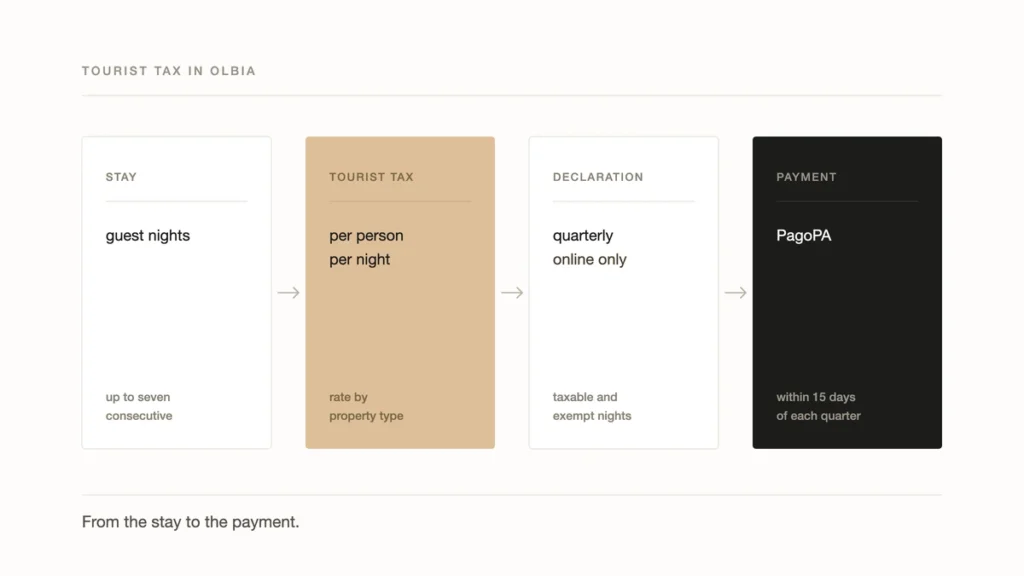
In short. Yes, Olbia charges a tourist tax, and if you let a property there you are the one the Comune holds responsible for it. Guests pay it, you collect it, you declare it and you pay it over to the municipality every quarter. For houses and flats the rate depends on your property’s cadastral category, not on your nightly price, and the tax stops after seven consecutive nights. Several exemptions apply, the largest being guests under sixteen. The detail that matters most is this: under the municipal regulation you owe the money to the Comune even if you never collected it from your guest.
What the tourist tax in Olbia actually is
The tourist tax — imposta di soggiorno in Italian, sometimes called city tax — is a municipal tax on overnight stays. It is not a national tax and it is not a regional one. Each comune decides whether to charge it, how much, and with which exemptions, within the limits national law sets. Olbia charges it under its own Regolamento per la disciplina dell’imposta di soggiorno, adopted on the basis of Article 4 of Legislative Decree 23 of 14 March 2011.
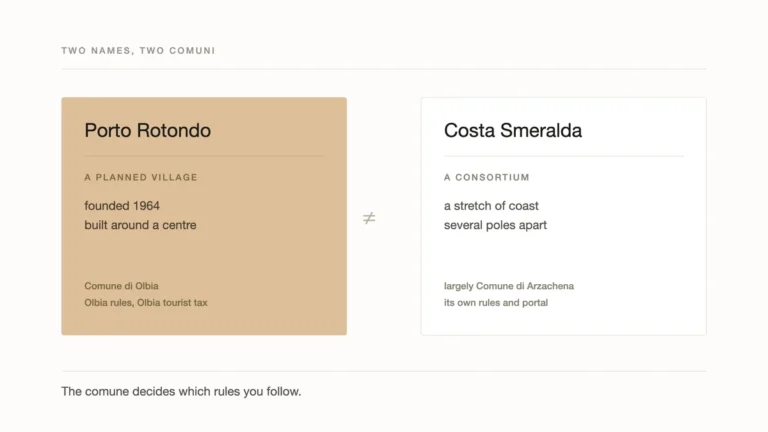
This has a consequence that catches owners out more often than anything else on this page: the rules below are Olbia’s rules. They apply to property inside the municipal boundary of Olbia and nowhere else. Golfo Aranci, Arzachena, San Teodoro and Loiri Porto San Paolo are separate comuni with their own regulations, their own rates and their own portals. If you own in more than one of them, you have more than one set of obligations.
It is also worth separating this tax from the money Booking.com may already be withholding from you. The 21% that platform deducts from some Italian hosts is income tax under the short-let rules — a completely different thing from the tourist tax, paid to a different authority for a different reason. Having one handled does not mean the other is.
Who pays it, and who does not
The tax is owed by people staying overnight who are not resident in the Municipality of Olbia. That is the wording of Article 3 of the regulation, and it is a point the Italian-language guides often skip: a guest who is registered as resident in Olbia does not pay, regardless of why they are staying.
Everyone else pays, for a maximum of seven consecutive nights, in any kind of accommodation inside the municipality — hotels, B&Bs, farm stays, campsites, holiday flats and short lets alike.
One definition in the regulation is broader than most owners expect. Article 2 brings in units let on short leases of not more than 30 days, whether for tourism or not, including transitional lettings. And it adds that tourist or recreational use is presumed unless the taxpayer proves otherwise. If you let your Olbia flat for three weeks to someone who is in town to work, the starting assumption is that the tax applies and the burden of showing otherwise is yours.
How much is the tourist tax in Olbia?
These are the rates in force from 1 January 2026, per person per night, capped at seven consecutive nights.
| Type of accommodation | Per person, per night |
|---|---|
| Hotels, 5-star and 5-star luxury | € 5.00 |
| Hotels, 4-star | € 4.50 |
| Hotels, up to 3-star | € 3.50 |
| Hotels, 1 or 2-star | € 2.50 |
| Houses and flats, cadastral category A/7 and above | € 5.00 |
| Houses and flats, category below A/7 | € 3.50 |
| C.A.V. and residences | € 3.50 |
| B&Bs, rooms to let, holiday houses, domos, hostels | € 3.50 |
| Farm stays and rural tourism | € 3.50 |
| Campsites | € 2.50 |
| Motorhomes and caravans | € 5.00 |
| Equipped motorhome and caravan areas | € 3.50 |
| Scattered nautical hotels | € 4.50 |
| Boat and breakfast | € 4.50 |
A note on the source of these figures. The tariff sheet published by the municipality’s collection company states that they were approved by Giunta Comunale resolution no. 534 of 13 November 2025 and are valid from 1 January 2026. The municipal web page, however, labels the 2026 rates with Consiglio Comunale resolution no. 36/2026 of 23 April 2026, which is the resolution that amended the regulation itself. The rates are the same in both places; only the act cited differs. We have not tried to resolve which reference is the correct one, and neither should you — the figures are what you apply.
Why your cadastral category decides the rate
If you let a house or a flat, your rate is not set by your nightly price, your floor area or any star rating. It is set by the categoria catastale, the category under which the property is recorded in the Italian land registry. Category A/7 and above pays € 5.00; anything below A/7 pays € 3.50.
In practice, A/2 (ordinary residential) and A/3 (economy residential) are the categories most Olbia flats fall into, and they pay the lower rate. A/7 covers small detached villas and A/8 covers villas, which is why a house at Pittulongu or Porto Rotondo often pays the higher one. Your category is on the visura catastale, and it also appears on your purchase deed and in your IMU calculations.
There is one honest gap here. The regulation says “category A/7 and above”, which plainly covers A/7 and A/8. For the high-value categories that carry lower numbers — A/1, stately dwellings, in particular — the wording is genuinely ambiguous. If your property is recorded as A/1, do not guess. Ask the Comune in writing before you set your season rates.
The 5% rule, and what is unclear about it
The regulation also provides, “on an experimental basis”, a second way of calculating the tax. Where the money for the stay is collected directly by an estate agency or by the operator of an online platform, the tax can be charged as a percentage of the cost of the room or flat instead of as a flat per-night amount. The Giunta set that percentage at 5%, with a ceiling of € 5 per person per night.
Two things about this rule are stated differently by two official municipal sources, and we are not going to pick one for you:
- The VAT basis. The regulation says the calculation is made on the cost of the room or flat, including any breakfast, net of VAT and of any additional services. The published tariff sheet says the same figure is inclusive of VAT and of any additional services. The two texts contradict each other.
- Who it applies to. The regulation describes it as applying to sums collected directly by intermediaries or platform operators. The tariff sheet restricts the same line to soggetti convenzionati — parties that have entered into an agreement with the Comune. Those are not the same group.
If the percentage basis could apply to how your bookings are paid, this is a question for ASPO before the season, not a question to answer by assumption. The regulation does allow the Comune and an intermediary to settle the operating detail by agreement, even departing from the regulation itself — so the answer may well be specific to the platform you use. We found no published agreement of that kind for Olbia.
How many nights are taxed?
Seven. The tax applies to a maximum of seven consecutive nights per guest, and the Comune is explicit that the limit exists to encourage longer, less seasonal stays. From the eighth night onwards, your guest pays nothing.
On a fortnight in August for four people in a flat below A/7, that is the difference between charging € 196 and charging the correct € 98. Most channel managers will happily compute the tax on every night of the stay unless you cap it yourself, which makes this the single most common way owners overcharge their guests.
There is a further rule, and it appears only in the information sheet the Comune publishes, not in the regulation. That sheet states that the period cannot be split: two nights a month for ten months does not earn the exemption, but once a guest has stayed seven consecutive nights, all their subsequent stays, even in different periods of the year, are not subject to the tax. Read literally that is generous to returning guests. Because it rests on a published information sheet rather than on the regulation, treat it as the Comune’s own stated reading and check it with ASPO before you apply it to a repeat booking.
Who is exempt?
The regulation lists eleven categories. Exempt are:
- children, up to the day they turn sixteen;
- people accompanying patients in local health facilities, one per patient;
- parents or carers of hospitalised under-eighteens, up to two per patient;
- non-self-sufficient disabled people recognised under Law 104/1992;
- their carers;
- coach drivers and tour guides, for each group of 25;
- police, armed forces, state and local police and fire service staff staying in Olbia on duty;
- anyone working at a local business or production site;
- university students up to 26 enrolled on a recognised degree course in Olbia;
- Erasmus-type students at a degree course or secondary school in Olbia;
- civil protection and voluntary association volunteers, in the event of natural disasters and major events identified by the administration.
Two of these are worth planning around. Under-sixteens is a high threshold — many Italian comuni stop at ten or twelve — and it means a family of two adults and two teenagers pays for two people, not four. Over seven nights in an A/7 house that is € 70 instead of € 140, and it is an argument worth making to families when they compare your listing with another. Guests working locally matters too: Olbia has a port, an airport and a marine and industrial supply chain, and technicians on assignment are exempt.
Exemptions are not free, administratively. For the two hospital-related categories, and for Erasmus students, the guest must give you a signed declaration under Articles 46 and 47 of Presidential Decree 445/2000, naming the people involved and the period. Keep it. Without the form, an exemption claimed verbally does not survive a check. And note that exempt nights still have to be counted and declared — not charging is not the same as not reporting.
What the owner has to do
| Obligation | Rule | Who is responsible | Deadline | Source |
|---|---|---|---|---|
| Tell guests about the tax | Display the application, the amount and the exemptions “in designated areas” | Manager / owner | Ongoing | Regulation, Art. 7(1) |
| Collect the tax | Guest pays the manager, who issues a receipt | Manager / owner | At the end of the stay | Regulation, Art. 6(1) |
| Quarterly declaration | Guests, nights, taxable and exempt nights, number of exempt guests, tax due, payment reference — online only | Manager / owner | Within 15 days, per Art. 7(2) | Regulation, Art. 7(2)-(3) |
| Quarterly payment | Municipal tourist tax portal, via PagoPA, with an IUV reference | Manager / owner | 15 Jan, 15 Apr, 15 Jul, 15 Oct | Regulation, Art. 6(2) |
| Annual declaration | Filed cumulatively and online with the Agenzia delle Entrate | Whoever collected the money | 30 June of the following year | Regulation, Art. 7(4); Art. 180(4) DL 34/2020 |
| Keep the records | Payment receipts, police notifications, regional statistical returns | Manager / owner | Until assessment deadlines expire | Regulation, Art. 7(6) |
The deadline wording in the regulation for the quarterly declaration is “within 15 days of the following month”, which is the regulation’s own phrasing and is not a model of clarity — the English information sheet repeats it verbatim. The payment dates, by contrast, are unambiguous: within fifteen days of each quarter end.
Then there is the sentence every owner should read twice. Article 3(4) makes the manager and the owner of the let property responsible for paying the tax, and obliges them to pay it to the Comune even if they did not collect it from the guest. If a family of six leaves without paying, the debt is still yours. The Comune has your name and your address; it has no reason to chase a departed visitor. That is why the tax is best requested at the start of the stay or announced at booking, even though the Comune’s own information sheet describes the guest as paying at the end — getting it from someone standing in front of you is a great deal easier than getting it from someone who has flown home. If a guest flatly refuses, the information sheet tells managers to have them complete a refusal form and send it promptly to the Comune.
Practically, the three record sets in the last row have to tell the same story. Your tax portal figures, your Alloggiati Web and SIRED returns and your regional statistics are all counting the same guests. Mismatches between the three are exactly what a municipal check looks for.
Does Airbnb collect the tourist tax in Olbia?
Possibly — and the honest answer is that only your own account can tell you.
Airbnb states that since 1 January 2024 it is required to collect tourist taxes for short-term stays of 30 days or less, and that it may collect and remit on your behalf if your municipality has registered with its dedicated portal. That condition is the whole question, and it is not something we can verify from outside for a specific town. Airbnb publishes the way to check it:
- open Listings and select the listing;
- go to Edit preferences, then Taxes;
- anything Airbnb collects appears under local taxes collected and remitted by Airbnb.
Three limits are worth knowing before you rely on it. First, the collection covers the short-let listing categories; if your property is registered as a non-hotel accommodation business — a B&B, rooms to let, a C.A.V. — Airbnb says you remain responsible yourself. Second, where Airbnb does start collecting, you stay responsible for every stay before the start date. Third, because Olbia sets its rate by cadastral category, Airbnb needs that category from you to charge the right amount: it can be entered under Edit preferences → Regulations → set the cadastral category for the applicable tourist tax. If you leave it blank, do not assume the € 5.00 or € 3.50 decision has been made correctly on your behalf.
Where Airbnb does collect and remit, it also files the annual tourist tax declaration for those stays. If you also let the same property directly, that does not cover you — more on which in a moment.
What about Booking.com?
Booking.com behaves differently, and assuming the two platforms work the same way is a reliable way to end up short.
Booking.com’s partner documentation says that where a tax is charged per person and is set as “excluded” in the Extranet — which is exactly how Olbia’s tax is structured — you collect it from guests yourself at check-in. The platform lists the countries where it collects per-person city and tourist taxes automatically: Portugal and France, plus a list of thirty-three countries added on 15 June 2026. Italy is not among them. There is an optional early-access programme for other countries, which a partner has to opt into on the VAT/tax/charges page.
Just as importantly, Booking.com states plainly that you remain responsible for remitting the taxes to the relevant authorities, and the only tax remittance arrangements it documents in detail are for Canada and the United States. So on the evidence Booking.com itself publishes: for an Olbia property, assume the collection and the payment are yours, and verify your own settings in the Extranet under Property → VAT/tax/charges. Note that you cannot change those settings yourself — the platform requires you to message them.
How you declare and pay
Everything goes through the municipal tourist tax portal. The tax is managed for the Comune by ASPO S.p.A., the municipality’s in-house company, and the portal runs on the “Soggiorniamo” platform, reachable at olbia.imposta-di-soggiorno.it, with a dedicated address at impostadisoggiorno@aspo.it.
The portal offers four routes, and which one suits you depends on how many bookings you handle:
- Dichiarazione Presenze — fill in the quarterly declaration directly and submit it, adding your payment details.
- Registro Presenze — log check-ins, check-outs and exemptions as they happen; the portal then generates the quarterly declaration already completed.
- Caricamento Presenze — bulk-upload check-ins and check-outs from your own property management system using the prescribed spreadsheet format.
- Modello 21 — which the portal states must reach the Comune by 30 January, by hand at the records office or by certified email with a digital signature. The current regulation does not mention this form, so confirm with ASPO whether it is still required alongside the ministerial annual declaration.
Payment itself is made through the portal via PagoPA, generating an IUV reference. Two thresholds are worth remembering: nothing is paid or refunded for amounts up to € 0.20, and refunds are not made at all for amounts of € 15 or less. Overpayments are normally recovered by offsetting them against a later quarter, using a form filed at least fifteen days before the next deadline; a straight refund claim runs for five years.
What if you live outside Italy?
This is more manageable than owners abroad usually fear, mostly because the municipal portal does not require an Italian digital identity.
- Have the property properly registered as a short let, with the codes that come with it. Our guide to the CIN and IUN in Sardinia covers that step.
- Know your cadastral category before the season, because it sets your rate. It is on the visura catastale.
- Register on the municipal portal. Access is by user code and password tied to your codice fiscale — the Italian tax code you will already have as an Italian property owner. SPID is not required for this, which is the single most useful fact on this page for a non-resident owner. Expect the portal’s content to be in Italian; the English URL path does not translate the pages behind it.
- Record stays as they happen rather than reconstructing them in January. Exempt guests included.
- Collect the tax when you or your representative meet the guest. If nobody meets them, read our guide to self check-in and keyboxes first: the money and the identification both have to happen somehow.
- Declare and pay each quarter through the portal and PagoPA.
- File the annual declaration with the Agenzia delle Entrate by 30 June of the following year — unless someone else collected the money, in which case see the next section.
- Keep everything: receipts, police notifications, regional statistics, exemption declarations.
Step seven is where a digital identity does become an issue, because the Agenzia delle Entrate is a different system from the municipal portal. There is a published route for people without SPID, CIE or CNS. The Agency’s own pages state that non-resident individuals over sixteen holding an Italian tax code may register for its online services, and that foreign individuals and legal entities obtain Fisconline credentials by completing the request form and sending it to the Centro Operativo di Pescara, by email or certified email. Italian citizens resident abroad follow a different path, through their consulate, and only in certain cases. Start that process well before June rather than in the week of the deadline.
There is also a measure that could simplify all of this considerably, and we can only report it with a caveat. A flat-rate option exists, or has existed, for holiday lets: a single annual payment per property, based on an estimate of guest nights, settling the year’s liability in place of the quarterly declarations. The Comune’s 2023 tariff sheet set it out in a footnote, with two annual amounts — one for houses below A/7 and a higher one for A/7 and above — and in May 2024 the Comune presented it again as open to managers with a small number of properties.
The difficulty is that the 2025 and 2026 tariff sheets no longer carry those footnotes, although both still print the two asterisks that referred to them, and the mechanism appears neither in the current regulation nor in the collection company’s 2026 forms. We have no basis for saying whether the option is still open, and the 2023 amounts should not be treated as current rates. If a single annual payment would suit you, that is precisely the question to put to ASPO before the season: whether it is available this year, for how many properties, and at what amount.
Can a property manager handle it?
Operationally, yes, and this is how most non-resident owners run it. Legally, the picture is more precise than “someone else takes care of it”, and the distinction is worth getting right.
Who files the annual declaration follows who collected the money. The Ministry of Economy and Finance’s published FAQs are explicit: under Article 4(5-ter) of Decree-Law 50/2017, for short lets the party that collects the rent, or that intervenes in its payment, is responsible for filing. Where an intermediary collects, the declaration “must be filed only by the intermediary”, and those stays must not be declared by the owner at all — not even in the exempt field. Where the owner also lets directly, they file too, but only for the stays they handled themselves. The FAQs also note that an agency must file a separate declaration with each comune where its managed properties are located, listing all of them.
What delegation does not do is make your liability disappear. The regulation permits the assumption of another party’s tax debt — accollo — on a form provided by the Comune, but expressly without releasing the original taxpayer, and it forbids settling an assumed debt by offsetting it against the assuming party’s own credits. So a manager can take the work, the portal, the deadlines and even the debt; the Comune can still come back to the owner. Anyone who tells you otherwise is selling something.
What happens if you get it wrong
The regulation sets these out article by article, so there is no need to speculate:
- Late, partial or missed payment: a penalty of 25% of the unpaid amount (Art. 10(2)).
- Missed, late, incomplete or inaccurate quarterly or annual declaration: 100% to 200% of the tax due and unpaid, with a minimum of € 500 for each declaration (Art. 10(3)-(6)).
- No reply to a questionnaire or document request: € 500 per instance (Art. 10(7)).
- Failing to display the tax information to guests: € 500 (Art. 10(8)).
The € 500 floor is the part that should concentrate the mind: a forgotten quarter on a quiet property can cost far more than the tax itself. Two further mechanisms matter. A declaration filed more than 90 days late is treated as void, which opens the door to assessment by inference — and in that case the Comune may estimate your taxable nights from your declared bed capacity and the occupancy rate of comparable local properties, using presumptions that need not be precise or consistent (Art. 9). Unpaid assessments go to enforced collection sixty days after notification. Disputes go before the tax courts.
Practical checklist
- Confirm the property is inside the Municipality of Olbia, not a neighbouring comune.
- Check your cadastral category and set the right rate — € 5.00 or € 3.50.
- If you are on Airbnb, enter the cadastral category in the listing and check the Taxes page for what Airbnb collects.
- On Booking.com, assume the per-person tax is yours to collect, and verify the Extranet settings.
- Cap the tax at the seventh consecutive night in whatever system you use.
- Exclude under-sixteens; identify other exempt guests and get their signed declarations.
- Display the tax information where guests can see it.
- Record every stay, exempt ones included, as it happens.
- Declare and pay each quarter through the portal and PagoPA.
- Reconcile against your Alloggiati Web and regional statistical returns before filing.
- File the annual declaration by 30 June, unless an intermediary collected the money.
- Keep receipts, notifications and exemption forms for the full assessment period.
Who is responsible for what
| Guest | Owner or manager | Platform | |
|---|---|---|---|
| Owes the tax | Yes, if not resident in Olbia | No, but is liable for paying it over | No |
| Pays it over to the Comune | No | Yes — even if not collected from the guest | Only where it collects directly |
| Quarterly declaration | No | Yes | Where it collects, under the Art. 6 obligations |
| Annual declaration | No | Yes, for stays it collected | Yes, for stays it collected |
| Proving an exemption | Provides the signed declaration | Keeps it and declares exempt nights | No |
| Exposed to penalties | No | Yes | For its own obligations |
Frequently asked questions
Does Olbia have a tourist tax?
Yes. Olbia charges a tourist tax on overnight stays under its own municipal regulation, for up to seven consecutive nights per guest.
How much is the tourist tax in Olbia?
From 1 January 2026, houses and flats pay € 5.00 per person per night if they are in cadastral category A/7 or above, and € 3.50 if below A/7. Hotels pay between € 2.50 and € 5.00 depending on their star rating, campsites € 2.50, and most non-hotel accommodation € 3.50. Where an intermediary or platform collects the money directly, the regulation provides for 5% of the cost of the stay instead, capped at € 5 per person per night.
How many nights do guests pay it for?
A maximum of seven consecutive nights. From the eighth night the guest pays nothing. The Comune says the cap is intended to encourage longer, less seasonal stays.
Are children exempt?
Yes, up to the day they turn sixteen. That is a higher threshold than many Italian municipalities, so a family with two teenagers pays for the adults only.
Does Airbnb collect the tourist tax in Olbia?
It may, but only if the Comune has registered with Airbnb’s tourist tax portal, and only for listings in the short-let categories. Check your own listing under Edit preferences → Taxes: anything Airbnb collects is shown there. If it is not listed, collecting and paying the tax remains entirely your responsibility.
Does Booking.com collect it?
On Booking.com’s own documentation, no. Where a tax is charged per person and set as excluded — Olbia’s structure — the platform states that you collect it from guests yourself at check-in, and that you remain responsible for paying it over. Italy is not in the list of countries where it collects per-person taxes automatically.
How do I pay the tourist tax to the Comune di Olbia?
Through the municipal tourist tax portal, managed for the Comune by ASPO, generating a PagoPA payment with an IUV reference. Payment is due within fifteen days of each quarter end: 15 January, 15 April, 15 July and 15 October.
What if I live outside Italy?
The municipal portal uses a user code and password linked to your Italian tax code, so SPID is not needed to declare and pay. For the annual declaration with the Agenzia delle Entrate, foreign individuals and companies can obtain Fisconline credentials by sending the Agency’s request form to its Pescara operations centre; Italian citizens resident abroad follow a separate route through their consulate.
Can my property manager handle it for me?
Operationally, yes. Under the ministerial FAQs, whoever collects the money files the annual declaration, so where an intermediary collects, the owner does not declare those stays. But the municipal regulation allows another party to assume the tax debt only without releasing the original taxpayer — so delegation moves the work, not your exposure.
The short version
Four variables decide what you charge in Olbia: the cadastral category of the property, the number of guests, their ages, and how many consecutive nights they stay. Get one wrong and you either overcharge your guests or pay the difference yourself. Everything else — the portal, PagoPA, the quarterly rhythm, the annual declaration, the reconciliation against your police and statistical returns — is administration that has to happen four times a year whether or not you are in Sardinia that week.
Own a property in Olbia? AirAffitti can run the operational side of short-term letting: listings and pricing, guest communication, check-in coordination, cleaning between stays, and the day-to-day administrative workflow that comes with stays — including applying the tourist tax at the correct rate, with the right exemptions, capped at the seventh night, and filing and paying it on the quarterly deadlines. What our management covers sets out the detail.
What we are not is a tax adviser, a tax representative or a law firm, and nothing here is tax or legal advice. We do not take over your position as the party the Comune holds responsible. For your own case, the municipal regulation and ASPO are the authorities, and a qualified Italian accountant is the right person to talk to.
Sources
- Comune di Olbia, Regolamento per la disciplina dell’imposta di soggiorno, as amended by Consiglio Comunale resolution no. 36 of 23 April 2026 — official PDF, consulted 5 October 2026.
- Comune di Olbia, Tariffe imposta di soggiorno 2026, approved by Giunta Comunale resolution no. 534 of 13 November 2025, in force from 1 January 2026 — tariff sheet published by the collection company, consulted 5 October 2026.
- Comune di Olbia, Imposta di Soggiorno institutional page, last updated 21 May 2026, and Ufficio Imposta di Soggiorno — consulted 5 October 2026.
- Comune di Olbia, Tourist Tax information sheet (English version) and the Italian equivalent — consulted 5 October 2026.
- Municipal tourist tax portal and collection company’s portal — consulted 5 October 2026.
- Ministry of Economy and Finance, Department of Finance, FAQ — Dichiarazione imposta di soggiorno, 19 September 2022.
- Legislative Decree 23 of 14 March 2011, Art. 4; Decree-Law 50/2017, Art. 4(5-ter); Decree-Law 34/2020, Art. 180(4); Legislative Decree 471/1997, Art. 13; Presidential Decree 445/2000, Arts. 46-47; Law 296/2006, Art. 1(168).
- Airbnb Help Centre, tourist tax collection and remittance in Italy; Booking.com for Partners, Understanding VAT and local taxes — consulted 5 October 2026, used only to describe each platform’s own stated behaviour.
- Agenzia delle Entrate, Credenziali Fisconline and Registrarsi ai servizi — consulted 5 October 2026.
This guide is for information only and reflects the rules in force on the date of publication. Rates, exemptions and deadlines are set by the Comune di Olbia and can change. For your own property, check with ASPO or the Comune’s tax office, or with a qualified Italian accountant.