Property Owners
How to Choose a Property Manager in Sardinia
Delegating a holiday let from abroad: the questions to ask, who files the CIN and the tourist tax, and what the commission really covers.
In short. Choosing a property manager from abroad is a different exercise from choosing one while living down the road. You cannot drop in unannounced, you cannot read the contract in your own language, and the formalities you are delegating are ones you often cannot perform yourself anyway. The lowest commission is rarely the best deal. What follows is the set of questions worth asking, including four that only apply if you live outside Italy.
A declaration first. AirAffitti is a property manager in Olbia. We have an interest in your answer. That is precisely why this piece sets out questions rather than conclusions, and why every answer we would give ourselves is stated plainly enough for you to hold us to it.
Why the questions change when you live abroad
An owner in Olbia can judge a manager on evidence that reaches them for free. They drive past the building. They hear from the neighbour. They know the cleaner. None of that reaches you in Rotterdam.
Three things shift as a result.
Verification becomes deliberate. What an owner nearby learns by accident, you have to go and check on purpose.
The formalities stop being optional to delegate. Italian public portals authenticate through SPID or CIE, the national digital identity credentials, which generally assume an Italian document. There are official routes for foreign owners — the Ministry’s accreditation procedure for the national database, and for Sardinia a published email channel for owners resident abroad — but they are slower, and most owners would rather hand the whole thing over. If you do, who actually performs it matters a great deal.
Response time stops being a convenience and becomes the whole service. A boiler that fails at 7pm in February is a phone call for a local owner. For you it is a problem you cannot see, cannot assess and cannot fix.
The seven questions everyone should ask
- What does it cost, really? Commission, fixed fees, activation charges, anything billed separately.
- What is included in that commission? Listings, guest communication, check-in, cleaning, the paperwork?
- How do you set and update prices? Every day, every week, or never?
- Who answers guests, and how quickly? A named person or a call centre?
- How am I paid, and how do I check the figures? Monthly statement, access to the calendar.
- Who handles the CIN, the police reporting and the tourist tax? You do is not the right answer.
- Can I use the property myself? With how much notice, and at what cost?
On price, a seasonal rate card means leaving money on the table. On paperwork, the owner takes care of that is the answer that should end the conversation — particularly if you are not in the country.
Four more questions, if you live outside Italy
1. Who performs each formality, and who is liable if it is not done?
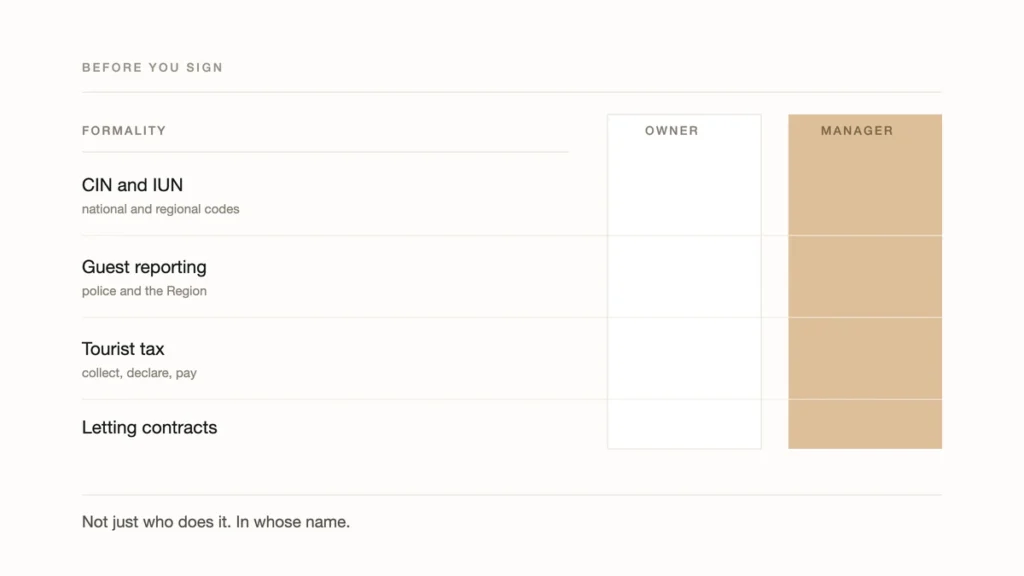
Be specific, item by item: the CIN and the regional IUN; the guest reporting to the police and to the Region; the tourist tax — collection, declaration and payment; the short-let contracts themselves.
Two details decide whether the answer is worth anything. Ask it to be in writing, in the contract, not agreed warmly on a call. And ask in whose name each filing is made, because a declaration filed in your name is still yours if it goes wrong. A manager who cannot say which of these they perform, under which credentials, has not thought about it.
2. Who talks to me, in what language, and how do I reach them?
Guest-facing languages are the question everyone asks. The one that matters more to you is the reverse: when you need an answer, who picks up, in which language, and on which day of the week?
Ask for a name. If after the first call you could not say who you spoke to, you have learned something.
3. How does the money reach me, and what has already been taken out of it?
Ask for a worked example on a real month: gross booking value, platform commission, management commission, cleaning, tax withheld, net transferred. Then ask on which date it is transferred and to which account — many owners want it to an account outside Italy, and it is better to know the answer before signing than after.
On the tax that is already gone: where an intermediary or a platform collects the guest’s payment, it acts as a withholding agent and 21% of the gross goes to the Italian authorities in your name. That is an instalment, not a settlement, and you will still have an Italian return to file. The detail is in our guide to how short lets are taxed in Italy. For this conversation only two things matter: the manager should hand you a withholding certificate, and they should keep direct bookings in a separate column, because nothing has been withheld on those.
4. What happens at two in the morning, in February, when I am two thousand kilometres away?
Winter is the real test. In August everyone is attentive. Ask who holds the keys, which plumber and which electrician they actually use, how a guest is rehoused if the property becomes unusable, and whether anyone checks on the place when it is empty for months. In a coastal flat, an unnoticed leak in January costs more than a bad August.
The answers to insist on
| Question | A healthy answer | A warning sign |
|---|---|---|
| Cost | Commission on what is actually collected | A fixed fee payable on an empty calendar |
| Prices | Updated daily against demand and events | A seasonal rate card |
| Guests | Reply within minutes, seven days a week | Office hours |
| Statements | Monthly, line by line | Everything at the end of the season |
| Paperwork | Included, itemised in the contract | The owner takes care of that |
| Contact | A named person you can reach | A different office each time |
| Exit | Notice period, no penalty | Multi-year lock-in with heavy exit fees |
What all-inclusive should actually mean
The phrase is used loosely, so test it against a list: listing and photography; daily pricing; guest communication seven days a week; check-in and check-out; cleaning and linen; minor maintenance; and the full set of formalities. If any of those is billed as an extra, it is not all-inclusive — it is a starting price.
And what it costs
Commissions quoted in this market generally run from 15% to 30% of revenue. That is an observation of what is offered, not a regulated scale, and a percentage on its own tells you very little.
Ours, since this is a page about choosing a manager and it would be evasive to leave it out: Standard Management at 15%, for owners who delegate the digital side and keep the keys, and Full Management at 20%, turnkey. Both only on completed bookings, with no fixed fee.
The comparison that matters is not the percentage. It is what reaches your account across a full year, after everything. A manager at 15% who never touches the price can cost you more than one at 20% who updates it daily.
How to check a manager actually exists
This is the part a non-resident skips and should not. None of it requires being in Italy.
- Ask for the company name, VAT number and registered office, not just a brand and a mobile number. Ask for the visura camerale, the company registry extract — it is the same document the Questura asks agencies and property managers to produce when they apply for access to the police reporting portal, so a working manager already has it to hand.
- Look at the properties they already run. Not the photographs of yours they promise, the listings that are live now.
- Check the CIN is shown in those listings. The code must appear in every advertisement wherever it is published, and portals are themselves obliged to display it. A manager running listings without one is telling you how they handle the rest.
- Ask for a sample monthly statement, with the figures redacted. Either it exists or it does not.
- Ask to speak to an owner they already work for. A reluctance to arrange it is itself an answer.
The contract
It will be in Italian and governed by Italian law. Read it, or have it read, and do not sign on the strength of a summary in your own language — if the two ever disagree, the Italian text is the one that counts.
Four points to find before you sign: how it ends, and what that costs; how much notice you need to block the calendar for your own use, and whether it is free; whether the manager may sign short-let contracts in their own name, which is not a formality but changes what the arrangement legally is; and who carries insurance for what, which we set out in our guide to insurance for holiday rentals.
On the third point, a note worth having. Under the Sardinian rules, signing letting contracts in one’s own name is treated as the distinguishing feature between running an accommodation business and acting as an intermediary — a distinction that affects classification rather than paperwork alone. Our guide to when a short let becomes a business goes into it.
Warning signs
- Multi-year contracts with heavy exit penalties.
- No names. You speak to a different office every time.
- Guaranteed occupancy. Nobody can guarantee that.
- A guaranteed annual income, with no explanation of who carries the risk.
- Photographs of the other properties they manage taken on a phone.
- Vagueness about the tourist tax and the police reporting.
- Pressure to sign before the season starts.
A checklist before you sign
- I have read the contract, in Italian, and understood all of it.
- I know exactly what is included and what is not.
- I have seen a sample monthly statement.
- I know who answers guests, and in which languages.
- I know who answers me, by name.
- Every formality is listed in the contract, with who performs it and in whose name.
- I know how and when money reaches my account, and what has been deducted first.
- I can block the calendar for my own use, with known notice and no charge.
- I can end the contract without a punitive penalty.
Frequently asked questions
How much does a property manager in Sardinia cost?
Commissions quoted in this market generally run from 15% to 30% of revenue, which is an observation of what is offered rather than a regulated scale. AirAffitti has two: Standard Management at 15% and Full Management at 20%, both only on completed bookings and with no fixed fee.
Can a property manager handle the CIN and the police reporting for me?
Yes, and for an owner living abroad that is often the main reason to use one. Have each item listed in the contract, with who performs it and in whose name, because a filing made in your name remains your responsibility.
Do I need to be in Italy to appoint one?
No. But you do need to verify deliberately what a local owner would learn by accident: company details, live listings, a sample statement, and a named person who answers the phone.
What does the 21% withheld from my bookings mean?
Where an intermediary or platform collects the guest payment, it withholds 21% of the gross and pays it to the Italian authorities in your name. It is an instalment on account, not a final settlement, and an Italian return is still required. Ask your manager for the withholding certificate, and keep direct bookings separate, because nothing is withheld on those.
Is a local manager better than a large platform?
For a single property, proximity usually wins: someone who knows the building, has a plumber who answers, and can be there in minutes. Platforms scale well, which is a different quality. Judge it on who will actually stand in your flat when something breaks.
Can I change manager if it is not working?
If the contract allows it. That is why the exit terms are worth more attention than the commission, and why multi-year lock-ins deserve suspicion.
Should I use a manager if I only let a few weeks a year?
Possibly not, and any honest manager will say so. Below a certain number of weeks the commission may not repay itself. What does not scale down is the paperwork: the CIN, the guest reporting and the tourist tax apply to a fortnight as much as to a season.
The short version
You are handing someone the keys to your house from several hundred miles away. Ask what it costs and what that includes; ask who performs each formality and in whose name; ask who answers the phone, and get a name; ask to see a monthly statement and the live listings; and read the exit clause before the commission.
If after the first call you do not know who you spoke to, you already have your answer.
AirAffitti manages short lets in Olbia, Porto Rotondo and along the north-east coast of Sardinia: listings, pricing, guest communication, check-in, cleaning between stays and the day-to-day running of the property. What our management covers sets out the detail, including where the formalities sit. We are not a law firm or a tax practice, and nothing here is legal or tax advice.
The commission figures described as the market range are an observation of what is quoted in this market, not an official statistic. The AirAffitti rates are our own published terms.