Property Owners
Insurance for Holiday Rentals in Italy
Does your home policy cover short letting? What Italian law requires, what Sardinia makes compulsory, and why AirCover is not insurance.
In short. The home insurance policy already in your drawer was almost certainly written for a different risk: a dwelling occupied by you, not one occupied by paying strangers on rotation. Italian law gives the insurer specific remedies when the declared risk and the real one diverge, so telling them is an obligation rather than a courtesy. Airbnb’s AirCover is a platform protection programme, not an insurance contract. And in Sardinia there is a statutory insurance obligation for structures organised for accommodation activity, backed by a fine of €1,000 to €6,000.
Why your existing policy may not respond
When you took out that policy, the insurer priced a specific picture: a residential dwelling, lived in by you and your family, with third-party liability referred to the facts of private life.
Putting the same flat into holiday letting changes several of the variables at once. The occupants are no longer your household but strangers changing every few days. The property stands empty and unattended for long stretches out of season. The activity has an economic dimension, and many family liability covers exclude damage connected with professional or business activity. And there are keys and access codes in circulation, which touches the theft section.
None of that is dramatic in itself. The difficulty is that the policy does not know about it, because you have not told them — and many policy wordings define the insured property by its intended use. If the real use is a different one, the discussion opens after the claim rather than before.
What Italian law says
This is not insurer sharp practice. The Civil Code gives them explicit tools.
Articles 1892 and 1893 deal with inaccurate statements and non-disclosure. If the policyholder gave inaccurate information, or withheld circumstances such that the insurer would not have written the risk, or not on those terms, the contract is voidable where there was intent or gross negligence. Even without either, the insurer may withdraw and the indemnity may be reduced.
Article 1898 deals with aggravation of the risk. The policyholder must give immediate notice of changes that aggravate the risk to the point that, had the new state of affairs existed at inception, the insurer would not have covered it or would have charged more. On receiving that notice the insurer may withdraw within a month.
Translated: if the policy was written when the house was your holiday home and today you let it to tourists all summer, telling the insurer is a legal obligation. And it works in your favour — the worst it costs you is a higher premium or a reworded contract, which is a far better outcome than a disputed claim.
An illustration, and it is only that
The scenario below is constructed to make the mechanism visible. It is not a real case and it does not describe a guaranteed outcome, which would depend on the wording of the individual policy and on the facts.
A two-room flat in Gallura, insured years ago when the family used it in August. Today it is listed from May to October. In July a flexible hose under the basin fails overnight; water crosses the floor slab and floods the flat below. The neighbour claims, and the owner notifies under the liability section. Working the file, the insurer notes that the property was occupied by paying guests that day, that the declared use was a different one, and that no notice of variation had been sent. The conversation stops being about how the damage happened and becomes about whether the cover responds.
Note the point: the damage was entirely ordinary. All it takes is for the real risk to differ from the one described in the policy.
Three pillars, and they do not substitute for each other
Most owners searching for holiday-let insurance are thinking about one thing: guests breaking the furniture. It is the least serious of the three.
1. Liability to third parties and to guests
The most important pillar, because the financial exposure is the largest and the least predictable. It covers damage you cause to others in connection with the property: a guest injured by a failing balustrade, a flooded neighbour, a falling roof tile.
Two provisions underpin such claims. Article 2043 of the Civil Code on compensation for wrongful acts, and article 2051, under which a person is liable for damage caused by things in their custody unless they prove it was a fortuitous event. That is a demanding standard: the burden of exculpation sits with the custodian.
Two details decide whether the cover is any use to you:
- it must apply to damage suffered by guests, not only by generic third parties — some wordings treat a paying guest as a third party, others do not;
- it must apply to all bookings, not only those made through a platform. If you take direct bookings, no platform protection follows you there.
2. Damage to the property and its contents
The one owners picture first: furnishings and appliances, and structural damage from fire, water or weather.
Keep two things apart here. The policy indemnifies you. Recovering from the guest is a separate, contractual route. Article 1588 provides that the tenant is liable for loss or deterioration of the let property during the tenancy, including by fire, unless they prove it occurred for a cause not attributable to them — and they are liable for damage caused by people they allowed to use it. That is a solid basis, but it is the basis of a civil claim you have to document, not an automatic refund. Which is why a written house rulebook and an up-to-date photographic inventory are not bureaucracy: they are the evidence, both towards the guest and towards your insurer.
3. Legal expenses
The pillar nobody talks about, and the first one you need when things get complicated. It does not pay the damage; it pays the cost of handling the dispute — legal advice, expert reports, court costs. Ask whether it is already in your contract: sometimes it is, with a narrow scope, and nobody has ever explained it to you.
Is insurance compulsory?
It depends on how the activity is classified and where the property is, and the honest answer has two halves.
Nationally: no general obligation
Article 13-ter of decree-law 145/2023 governs tourist lettings, short lets and the CIN. It requires the CIN for every unit, to be displayed and quoted in every listing; for units run in business form, the safety requirements for installations and the SCIA to the municipality; and, for every unit without exception, working detectors for combustible gas and carbon monoxide, plus compliant portable fire extinguishers — one per 200 square metres of floor area or part thereof, with a minimum of one per storey.
Note what is not in that list: any obligation to take out a policy. On the face of the provision there is no general national insurance requirement for tourist letting. Which does not mean there is none elsewhere.
In Sardinia: the obligation exists, with a fine
Regional law 16/2017 governs accommodation structures. Article 19(1)(c) requires all structures organised for carrying on accommodation activity to “take out suitable insurance covering civil liability towards clients”.
It is not a recommendation. Article 26(3)(c) sets an administrative fine of €1,000 to €6,000 for an operator who fails to take out that policy, doubled on repeat. For completeness, the same article at paragraph 2 punishes carrying on one of the article 13 activities without authorisation with a fine of €2,000 to €12,000 — a different and more serious case than simply lacking cover.
What that policy has to cover
The implementing directives are more precise than the law, and this is worth taking to your insurer. The cover must extend to all possible damage to property and persons inside the structure and in the areas and premises connected to it, and it extends to accessory services. And the policy must also insure the liability under articles 1783 and following of the Civil Code — the liability for items brought into the premises by the client.
That is a specific requirement, and general third-party liability does not automatically satisfy it. Check the wording.
The point where the rule is not clear-cut
Here honesty matters, because this is the boundary people get wrong.
The article 19 obligation is written for structures organised for carrying on accommodation activity — the categories listed in article 13. A pure tourist letting, a property let without accommodation services and not organised as a business, is not one of those categories and is not the direct addressee of the rule. However: the boundary between a tourist letting and a C.A.V. is not drawn by eye — it depends on the number of units, the services, the continuity and the organisation. Municipal rules can add requirements of their own, and the Gallura comuni are not necessarily aligned with each other.
So if you run several units, offer services or have a standing organisation, do not assume you fall outside. Anyone who tells you that in Sardinia insurance is never required, or always required, is simplifying twice.
Where AirCover and the security deposit fit
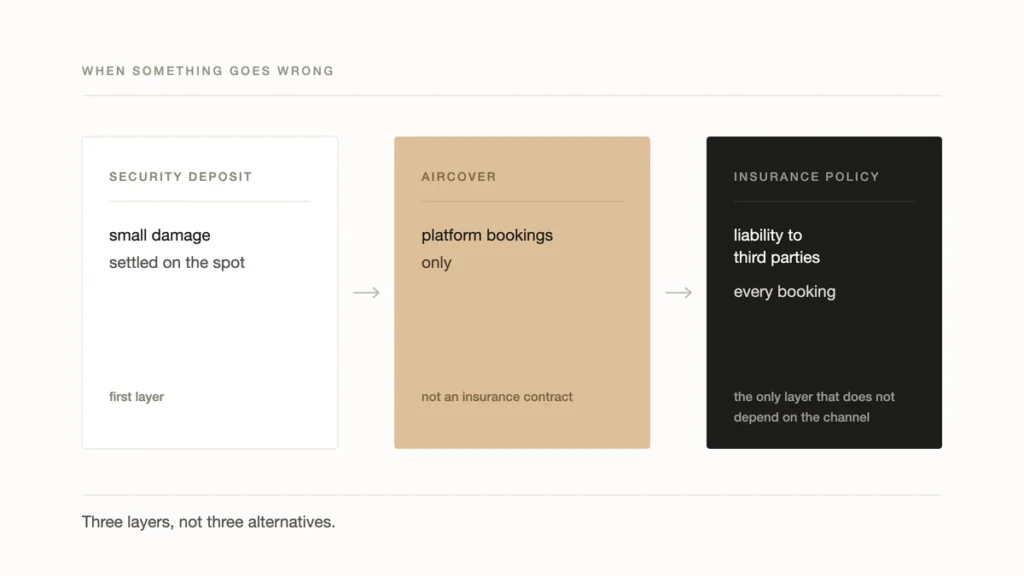
The three are not alternatives. They cover different moments of the same story.
The security deposit is the first layer: a modest amount, useful for small damage established straight away.
AirCover is the second, and it applies only to bookings made on the platform, with the conditions, limits and deadlines the platform sets. Airbnb itself describes it as a protection programme. It is not an insurance contract between you and an insurer, it is not governed by the Civil Code rules on insurance, and it is not an IVASS-supervised product.
The policy is the third layer — the only one that addresses the heaviest risk, a third party’s claim for compensation, and the only one that does not depend on the booking channel.
Put crudely: the deposit is for the broken vase, AirCover for the damaged furniture, the policy for the flooded neighbour’s lawyer.
Ten questions for your insurer
Take these and ask for written answers, with reference to the policy articles. If your contact will not answer in writing, that is itself information.
- What is the declared use of my property in the policy, and in which article is it defined?
- Is letting for tourist purposes, even occasionally, compatible with this policy, or is it among the exclusions?
- Do I need to file a formal notice of aggravation of risk under article 1898? On what form, and within what time?
- Does the liability section treat a paying guest as a third party? Does it cover damage caused by guests to third parties, as well as damage caused by me?
- Do the covers apply to direct bookings, outside the platforms?
- How is the property treated when unoccupied for weeks or months? Do keys and codes given to unknown guests affect the theft cover?
- Is legal expenses cover included, with what scope, and does it extend to disputes with guests and with the building’s other owners?
- Is there cover for lost income if the property becomes uninhabitable, and how is the indemnifiable period calculated?
- If I operate as a C.A.V. or other accommodation structure in Sardinia, does this policy satisfy the regional liability requirement — including the liability under articles 1783 and following?
- What are the deductibles, excesses and limits for each section?
The last one saves the most money. A high limit sitting behind a large excess can be worth less than a lower limit without one.
Frequently asked questions
Is insurance compulsory for holiday lets in Italy?
It depends on the classification and the region. Nationally, article 13-ter of decree-law 145/2023 imposes no general insurance requirement. In Sardinia, regional law 16/2017 requires structures organised for accommodation activity, including C.A.V.s, to carry liability cover towards clients, with a fine of €1,000 to €6,000 if they do not. A pure, non-business tourist letting is not the direct addressee of that rule, but the boundary is technical and worth checking.
Does my existing home policy already cover short letting?
That cannot be known without reading your contract. Many policies define the property by its intended use and treat letting to third parties as a circumstance to be declared. Check the covered and excluded sections, the contractual definitions, and get a written answer from your intermediary.
If I do not declare the letting, can I really lose the cover?
The risk comes from the law, not from the insurer’s ingenuity: articles 1892 and 1893 on inaccurate statements and non-disclosure, article 1898 on the duty to notify an aggravation of risk. The consequences depend on the case, but the position of someone who did not declare is structurally weak.
Can AirCover replace liability insurance?
No, for two reasons. By nature it is a platform protection programme rather than an insurance contract. And by scope it does not follow you to direct bookings.
What does a holiday-let policy cost?
No sensible figure can be given without knowing the property, the sections, the limits, the excesses and the claims history. Ask two or three quotes on the same set of covers and compare the wordings rather than the premiums.
Who insures, the owner or the manager?
They are different positions and can coexist. If you hand the property to a manager, ask what cover they carry and what remains with you.
I live abroad. Does that change anything?
The property is in Italy, so Italian law governs the contract and the liability rules described here apply regardless of where you live. What it does change is practical: make sure you can be reached quickly for a claim, and that someone on the ground can document damage while it is still visible.
The short version
You do not need “an insurance policy”. You need to know what the contract you already hold actually says. Three steps, in order, and the first two are free: reread your policy looking for the declared use and the exclusions; write to your intermediary stating that the property is let to tourists and ask for a written answer on whether the covers respond; only then consider adding to or replacing it, starting with liability towards third parties and guests.
If you run several units or offer services, add a step: work out which category you fall into under the Sardinian rules, because there the obligation is statutory and carries a fine.
AirAffitti manages short lets in Olbia and Gallura, and placing each property correctly within the rules is part of the job: classification of the activity, CIN and IUN, safety requirements, documentation of damage. We do not sell insurance. What we can do is put you in a position to ask your insurer the right questions. What our management covers sets out the rest.
Nothing here is insurance, tax or legal advice. Policy wordings, regional implementing directives and municipal rules change, and have to be checked in their current version with your own insurer, the relevant comune and a qualified professional.
Sources
- Regional law of Sardinia 16 of 28 July 2017, published in the BURAS — article 19(1)(c) on the liability insurance obligation, article 26(3)(c) on the €1,000–6,000 fine and article 26(2) on the €2,000–12,000 fine for unauthorised activity.
- Implementing directives for non-hotel accommodation structures, article 12 — what the policy must cover, including liability under articles 1783 and following of the Civil Code.
- Decree-law 145/2023, article 13-ter — CIN, safety equipment and SCIA; no insurance obligation.
- Italian Civil Code — articles 1892 and 1893 (inaccurate statements and non-disclosure), 1898 (aggravation of risk), 2043 and 2051 (liability, including for things in custody), 1588 (tenant’s liability), 1783 and following (liability for items brought in by the client).
- IVASS, consumer guidance on liability insurance — how limits, excesses and exclusions work.
The claim scenario above is illustrative and does not describe a real case or a guaranteed outcome. This guide is for information only.