Visiting Olbia
Things to Do in Olbia: The City Beyond the Port
Olbia is crossed by millions and visited by few: a museum of Roman shipwrecks, the oldest church in Sardinia, Punic walls in a side street. How to fit it in.
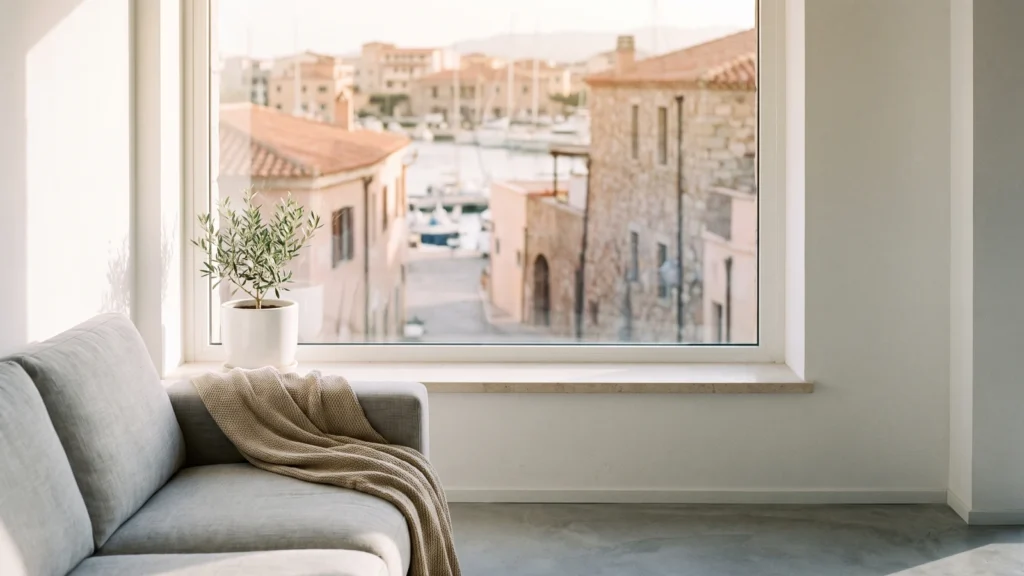
Most people cross Olbia rather than visit it. You land or you dock, you collect a car, and you drive north to the Costa Smeralda on the understanding that there is nothing here to stop for. That belief is common and easy to disprove: Olbia has been lived in without interruption for more than two thousand years, and the layers are still there at street level.
A museum built in the shape of a moored ship, holding more Roman ships than anywhere else in Italy. The oldest surviving evidence of Christianity in Sardinia. Punic walls folded into an ordinary side street. A Nuragic sacred well a few kilometres out of town. Half a day covers the city on foot; a full day covers the city and the archaeological sites around it.
The Greeks called the place olbìa, meaning happy.
What Olbia is genuinely good at
Two of the claims made for this city by the Regione Sardegna’s own tourism board are unusual for somewhere of its size, and they are the reason the half day is worth spending.
- The Archaeological Museum holds the largest number of Roman ships and ship remains in Italy. The region describes it as a museum on the sea, unique in the world.
- The basilica of San Simplicio is the oldest surviving evidence of the spread of Christianity on the island, and the best-preserved Romanesque basilica in Sardinia.
Neither is something you glance at on the way somewhere else.
The Archaeological Museum
It stands on the islet of Peddone, a few steps from the old port, and it is built in the shape of a moored ship: circular windows, suspended walkways. That is not an architectural flourish. The city was born on its harbour and grew on it, and the building says so before you are through the door.
Inside, the route runs through the Phoenician, Greek, Punic, Roman, medieval, modern and contemporary periods. Two things set it apart from a provincial archaeological collection.
The wrecks. In July 1999, during work on a tunnel below sea level at the old port, excavations led by Rubens D’Oriano uncovered the remains of ancient ships and their cargo. Twenty-four wrecks were recovered in good condition: two from the age of Nero, sixteen from the fifth century AD, and two from the Giudicati period. Some of them went down during a Vandal raid on the port. These are not fragments in a case — they are hulls.
The hoard. Among the material returned by the excavations is a hoard of almost 900 gold coins, now held in the museum.
If you have time for one thing only in Olbia, this is the one. Opening arrangements change through the year, so check the museum’s current hours before you build a morning around it. It is also the one thing in the city that reliably holds a child’s attention, which we come back to in Olbia with kids.
The basilica of San Simplicio
Built between the end of the eleventh century and the beginning of the twelfth, at the will of the giudici of Gallura, San Simplicio is the most important religious monument in north-eastern Sardinia and the oldest surviving evidence of Christianity on the island. It sits on a low rise that once stood outside the city walls, which is why it feels slightly set apart from the modern centre rather than at the heart of it.
It is dedicated to Simplicius, a bishop martyred on 15 May 304 during the persecutions under Diocletian. That one date still organises the city’s year.
At the foot of the altar is the necropolis museum: a Punic-Roman and later Christian burial ground of 450 tombs, brought together beneath the church. You go down a level and cross eighteen centuries of burials without leaving the same patch of ground. It is an unusual idea, and it works.
The patronal festival
Olbia celebrates its patron saint in mid-May — sa festa manna de Mesu Maju, the great feast of mid-May — with the celebrations building to 15 May, the saint’s own day. A procession is accompanied by a parade in traditional costume, and the programme includes the palio della Stella, a contest on horseback. The exact dates and the full programme are published each year by the Comune di Olbia. If your trip falls in that week, the city is a different place for a few days.
Roman and Punic Olbia, at street level
The ancient city is not in a fenced park. It is inside the modern one, which makes it easy to walk past without noticing — and rather more satisfying when you know where to look.
| What | Where, and what survives |
|---|---|
| The Punic walls | The Carthaginians ringed the settlement with walls and towers. A stretch is visible in via Torino; the visitable section, between via Torino and via Acquedotto near the central post office, is a double curtain of granite blocks with a gateway and a rectangular tower |
| The Roman forum | Traces survive near the town hall, which stands on the forum’s own ground, close to the port |
| Roman paving | A stretch of the original surface is visible at the junction of via Dante and corso Umberto I — the easiest piece of Roman Olbia to find on a walk |
| The aqueduct | Dated to the first and second centuries AD, and described by the region as the most intact in Sardinia. The remains lie outside the centre and need a car |
| Villa s’Imbalconadu | The remains of a Roman villa of the first century BC, in the countryside around the city |
The sequence behind all this is worth holding onto. Phoenician and then Greek traffic reached the territory from the seventh century BC; the first permanent settlement was Punic, in the fifth and fourth centuries BC. Rome took Sardinia in 238 BC, and Olbia became the principal centre of the island’s eastern coast — a town of around five thousand people, with paved streets, baths, a forum and that aqueduct.
The church of San Paolo
Baroque, and recognisable from some distance by its dome of iridescent majolica tiles. It is the other religious building in Olbia worth stopping for, and because it sits in the middle of the centre it falls naturally into a walk along the main streets rather than demanding a trip of its own.
That walk — corso Umberto, the side streets, the square — is also where the city does its ordinary business, and it is the part of Olbia that most visitors never see at all.
Nuragic Olbia, and a castle
Here you leave the city, and you will want a car. Human presence in this territory is attested from 4000–3500 BC, in dolmens, menhirs and megalithic circles, and around fifty Nuragic settlements survive from the Bronze Age. Four sites and one castle are the ones worth the drive.
| Site | What it is |
|---|---|
| Pozzo sacro di sa Testa | A Nuragic sacred well of the fifteenth to thirteenth centuries BC, built for water rituals, just outside the built-up area. Just under eighteen metres long, in granite, trachyte and schist; seen from above the plan resembles a keyhole, read as a door between the living and the dead |
| Nuraghe Riu Mulinu | On the peak of Cabu Abbas at almost 250 metres, dated to the fourteenth and thirteenth centuries BC. A single circular tower about eight metres across, inside a wall running 220 metres around the hilltop and built into the rock outcrops. The view reaches Tavolara |
| Su Mont’e s’Abe | A giants’ tomb opposite the castle of Pedres, and a collective burial rather than an individual one. Built first as an allée couverte in the Bonnanaro culture, then remodelled around 1600 BC into a giants’ tomb with exedra and stele; it was originally laid out in the shape of a bull’s head |
| Villaggio di Belveghile | A Nuragic settlement in the territory, listed by the region among the principal ones |
| Castello di Pedres | Medieval rather than Nuragic: a granite outcrop at about 140 metres, five kilometres south of the city. Probably built in the thirteenth century under the Visconti of Pisa, later entrusted to the Hospitallers of St John of Jerusalem and then held by the Aragonese, and abandoned from the following century. With San Simplicio, one of Olbia’s two significant medieval monuments |
A word of realism. These are archaeological areas, not museums: facilities, access and opening vary from site to site and from season to season, and some of it changes year to year. Check before you set out. Getting to them is a question of transport rather than distance — our guide to getting around Olbia covers when a hire car earns its keep and when it does not. Once you are driving anyway, these sites sit alongside the other day trips from Olbia.
Fitting it into the time you have
Olbia rewards a plan more than a long stay, because the pieces are close together and the opening hours are the only real constraint.
| Time available | What to do |
|---|---|
| One morning | The Archaeological Museum and San Simplicio. These are the city’s two halves — the harbour and the early church — and between them they explain it |
| Half a day | Add the necropolis museum beneath the basilica, then walk the centre for San Paolo and the Punic walls in via Torino, with the Roman paving at via Dante. All on foot |
| A full day | Add sa Testa and Riu Mulinu by car, and the castle of Pedres if you want the view as well as the stones |
| A wet day | The Archaeological Museum and the necropolis museum are both indoors, and rain is the best possible excuse to see them slowly |
If the weather turns the other way, the coast is the obvious alternative and the beaches near Olbia are close enough that you can change your mind over breakfast.
Frequently asked questions
Is Olbia worth visiting, or is it just a gateway?
It is worth half a day. The Archaeological Museum holds the largest number of Roman ships and ship remains in Italy, and the basilica of San Simplicio is the oldest surviving evidence of Christianity in Sardinia. Those are not things you find in a town you only pass through.
What is there to see at the Archaeological Museum of Olbia?
A route through the Phoenician, Greek, Punic, Roman, medieval, modern and contemporary periods, built around the twenty-four wrecks recovered from the old port in 1999 and a hoard of almost 900 gold coins. The museum itself is shaped like a moored ship and stands on the islet of Peddone.
How old is the basilica of San Simplicio?
It was built between the end of the eleventh and the beginning of the twelfth century, for the giudici of Gallura. It is the most important religious monument in north-eastern Sardinia, the oldest Christian evidence on the island, and the best-preserved Romanesque basilica in Sardinia.
Are there Nuragic sites near Olbia?
Yes. Around fifty Bronze Age Nuragic settlements survive in the municipal territory. The best known are the sacred well of sa Testa, the nuraghe Riu Mulinu on Cabu Abbas, the giants’ tomb of Su Mont’e s’Abe and the village of Belveghile. The medieval castle of Pedres is five kilometres south of the city.
When is the festival of San Simplicio?
In mid-May, building to 15 May, the saint’s day. It includes a procession with a parade in traditional costume and the palio della Stella, a contest on horseback. The Comune di Olbia publishes the dates and programme each year. If you are still choosing your dates, our guide to the best time to visit Olbia goes through the year month by month.
What is there to do in Olbia when it rains?
The Archaeological Museum and the necropolis museum beneath San Simplicio are both indoors, and together they comfortably fill a wet day — arguably the best day to visit them, without the beach pulling you away.
Read also
- Where to stay in Olbia: the areas, and who each one suits
- Getting around Olbia: car, bus, taxi and parking
- The best beaches near Olbia, and how to reach them
- All our English guides to Olbia and north-east Sardinia
A city that opens up if you stay in it
The difference between crossing Olbia and visiting it is almost entirely a matter of hours. People who sleep in the city discover that the two or three spare hours before a flight or a ferry — the ones that usually feel like dead time — are exactly what the museum needs.
AirAffitti manages apartments and rooms in Olbia and Porto Rotondo. If you are weighing up where to base yourself, or thinking of staying one more day rather than leaving straight away, you can see what we have available.
AirAffitti editorial team