

Visiting Olbia
Olbia with Kids: A Practical Family Guide
Short transfers, two shallow-water beaches and a museum children actually like. What to ask before booking, when to come, and whether you need a car.
Olbia works well with children for an unglamorous reason: the distances are short. The airport is four kilometres from the centre, the port is in the town itself, and the two main beaches are a short drive out. The transfer that ruins the first day of a family holiday barely exists here. What changes the experience most is not the town but two decisions you make before you arrive: which area you sleep in, and whether you have a car.
This guide is about the decisions, not the sights. Where the detail lives in another guide, we link to it rather than repeat it.
Is Olbia good for families?
Yes, with one qualification worth understanding before you book.
What works is the geography. Everything a family needs daily — a pharmacy, a supermarket, a flat walk, a restaurant that is open early — is in a compact town, and the sea is close enough that a beach day does not require a dawn start. Two of the beaches nearest the city are described by the regional tourist board as suitable for families with children, on the basis of their shallow, gently shelving sand.
The qualification is that Olbia is a working town, not a resort built around children. There is no family entertainment complex, and the city centre is a centre rather than a playground. Families who enjoy it are the ones who treat Olbia as a comfortable base with easy days, not as an attraction in itself.
Arriving with children
The single biggest advantage is the short transfer. Geasar, the airport operator, puts the airport four kilometres from the city centre, so even a delayed evening flight does not turn into an hour in a car with exhausted children.
Three practical points that are specific to travelling with children:
Book the car seat with the car, not on arrival. It is the item most often missing or unexpectedly priced, and the desk is a bad place to discover that. The car hire terminal is outside the terminal building, about 50 metres from arrivals and reachable on foot, so you will be collecting the car with luggage and children in tow.
On an overnight ferry, book the cabin. A reclining seat can work for one adult. With children it means starting the holiday already exhausted, and the saving is not worth the first day.
The port has a free shuttle bus. The Port Authority runs it inside the port area for embarking and disembarking passengers, connecting the maritime station with the berths at near-continuous frequency while ships are moving. With a pushchair and luggage this matters more than it sounds.
Whether to fly or sail is a separate question, and our guide to how to get to Olbia works through it.
Where to stay in Olbia with children
The area question has a different answer for families than for anyone else, because the variable is not scenery but daily friction.
Staying in the centre means you can walk to everything, which with young children is worth more than a view. It also means parking is the one real difficulty, and unloading a car near the door becomes a genuine consideration rather than a luxury.
Staying on the coast puts the beach at your doorstep and makes a car compulsory, including for bread and a pharmacy. That trade is fine with older children and harder with a baby.
Our guide to where to stay in Olbia compares the areas one by one. The family-specific layer is in the next section.
The questions worth asking before you book
This is the part that prevents most problems, and none of it is usually in a listing. Ask before you book, not on arrival.
About the property. Is there a cot or travel cot, and is it included or charged? Is there a high chair? Which floor is it on, and is there a lift — with a pushchair this changes everything? Are there guards on windows, balconies or stairs?
About the location. How is parking regulated in that street? How far is the nearest supermarket and pharmacy on foot?
About the logistics. What time is check-in, and what happens if the flight or the ferry arrives earlier?
On cots and high chairs in particular: check the details of the individual property, or ask us before you book. Availability is not guaranteed and varies from property to property, so it is worth settling while you are still packing rather than at the door.
None of these questions is obvious, and a serious host answers each one specifically. Vague answers about cots, floors and parking are themselves the answer.
Beaches that work with children
We are not going to describe the beaches twice. Two of them matter to a family, for reasons the official descriptions already supply.
La Playa di Pittulongu, north of the city, is singled out by the regional tourist board for its shallow, gently shelving seabed. It is also the better serviced of the two, and it lists accessible facilities for visitors with disabilities — information families rarely find written down anywhere.
Porto Istana, on the south-eastern side, earns the same description for its sand. Its family advantage is structural rather than scenic: it is four coves rather than one beach, so a crowded arrival means a short walk instead of a second drive.
Conditions are not guaranteed by any of this. Wind and sea change daily, and a beach that is calm one morning is not the next. Our guide to the beaches near Olbia covers the full picture, including which side suits which wind.
Things to do in Olbia with children
The city’s strongest card with children is also its main museum, which is not a sentence you often get to write.
The Archaeological Museum does half its work before you are inside, because the building itself is shaped like a moored ship, on an islet beside the old port. What is on display inside is mostly ships too: wrecks raised from the old harbour, and a hoard of gold coins. Ships, wrecks and treasure hold a child’s attention in a way a case of pottery does not. The figures and the history behind them are in the guide linked below.
Beyond the museum, the centre is compact enough to cross on foot, which is the fact that matters when you are pushing a pram rather than carrying a map. How easy any particular street is will depend on the pavement and the kerbs, as it does in any old centre. What else there is to see, and how long each thing takes, is in our guide to things to do in Olbia.
What to do on a windy or cloudy day
In Gallura this is a question you will actually face, because the mistral is a regular feature rather than an exception.
The first move is not indoors. Olbia has coastline facing two different directions, so a wind that makes one side uncomfortable often leaves the other usable. Checking before you load the car is the cheapest fix there is.
When that does not work, the museum is the answer, because it is indoors and because it is genuinely interesting rather than merely dry. A rainy morning is arguably the best time to see it properly.
Do you need a car in Olbia with children?
For the city, no. For a holiday built around beaches, in practice yes.
Buses do reach parts of the coast in the warm months, but a bus timetable with small children, beach equipment and a fixed return is a different proposition from a bus timetable with two adults. The car is not about distance here; it is about not having to be anywhere at a particular minute.
If you would rather not drive, the answer is to stay central and accept fewer beach days rather than to stay on the coast without a car. Our guide to getting around Olbia has the networks, the parking zones and the detail.
Family day trips from Olbia
Three that make sense with children, out of a longer list.
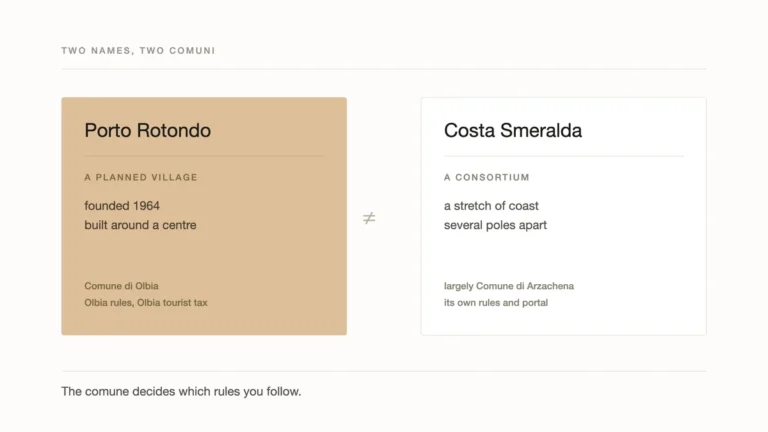
Porto Rotondo is the gentlest, and the only one an urban bus reaches: a marina, a village laid out to a Venetian idea, and a half day rather than a whole one. With young children, a half day out is usually the right size.
Golfo Aranci works if your children are old enough to walk. The Capo Figari promontory is protected for its wildlife and gives you a real walk with the sea on three sides. With a toddler it shrinks to a village visit, which is a perfectly good half day in itself.
Arzachena’s archaeology suits older children in particular. La Prisgiona is a Nuragic fortress with a village around it, outdoors and large enough to walk through rather than file past. Pick one site, not seven.
The rest, including the boat trips to Tavolara and the La Maddalena archipelago, are in our guide to day trips from Olbia.
When to come with children
Not August, if you have the choice.
July and August concentrate the heat, the crowds, the full beach car parks and the highest prices. June and September give you usable sea with noticeably fewer people, and with small children the difference between a packed beach and a breathable one is most of the holiday. September has the warmer water; June has the longer run before Italian schools break up.
Outside those months the sea becomes a gamble and the coastal services thin out, which matters more to a family than to a couple. Our guide to the best time to visit Olbia goes month by month.
A simple family plan
The principle is fewer moves and more margin. A holiday that looks efficient on paper is usually the one that falls apart by Wednesday.
| If you have | Suggested rhythm |
|---|---|
| One day | One thing, not three. Either a beach morning or the museum, plus a walk in the centre. Leave the second idea unused |
| Two days | One beach day and one town day. Keep the town day for whichever morning the wind is wrong |
| Three to four days | Two beach days on different coasts, one town day, and one half-day trip. Nothing on the arrival day and nothing on the departure day |
| A week | The same, spread out, with at least two days where the plan is deliberately nothing |
A second table, for the decisions that recur:
| Need | What to consider |
|---|---|
| Beach days | Access and parking, what services are actually open, and which coast the wind is on that morning |
| Travelling without a car | The area you sleep in stops being a preference and becomes the main constraint |
| Babies and toddlers | Floor and lift, cot and high chair, shorter days, and unloading the car near the door |
| Older children and teenagers | A wider range of day trips, longer walks, and the archaeology becomes worth the drive |
Frequently asked questions
Is Olbia good for families?
It works well as a base rather than as an attraction. The distances are short — the airport is four kilometres from the centre and the port is in the town — and two of the nearest beaches are described by the regional tourist board as suitable for families with children. It is a working town rather than a resort, so families who enjoy it are the ones planning easy days.
Do you need a car in Olbia with kids?
Not for the city, which is compact and walkable. For a holiday built around beaches, in practice yes: buses reach parts of the coast in the warm months, but with small children, beach equipment and a fixed return time, a car removes the timetable from the day.
Which beaches near Olbia are suitable for families?
La Playa di Pittulongu, whose seabed the regional tourist board describes as shallow and gently shelving, and the four coves of Porto Istana, described as particularly suitable for children. Conditions still depend on the wind and the day, so neither is a guarantee.
What can you do in Olbia with children?
The Archaeological Museum is the strongest option, and an unusually easy sell: the building is shaped like a moored ship and what it displays is mostly ships, wrecks and treasure. Beyond that the centre is compact enough to cross on foot, and the beaches are a short drive out.
Is Olbia good with a baby or toddler?
It can be, and the decisive factors are the property rather than the town: which floor, whether there is a lift, and how parking works in that street. For a cot or a high chair, check the individual property’s details or ask us before booking — availability is not guaranteed and varies from property to property.
How many days do families need in Olbia?
Three to four is comfortable: two beach days on different coasts, one town day and one half-day trip, with nothing planned on the arrival and departure days. One day is enough for either a beach or the museum, not both.
Read also
- Where to stay in Olbia: the areas, and who each one suits
- The best beaches near Olbia, and how to reach them
- Best time to visit Olbia: a month-by-month guide
- Day trips from Olbia: places to explore nearby
- All our English guides to Olbia and north-east Sardinia
Ask first, so you do not find out later
The things that matter when you travel with children — the cot, the floor, the lift, the parking, the check-in time — are almost never in a listing. They have to be asked, and a serious host answers precisely.
AirAffitti manages apartments and rooms in Olbia and Porto Rotondo. Tell us how many you are, the ages of the children and how you are arriving, and we will tell you exactly what is available and what is not. Once you know which area suits your family, you can see what we have available.
AirAffitti editorial team
Keep reading
Travelling as a family, the apartment near the town centre sleeps four in two separate bedrooms, with a full kitchen and free private parking. Apartment near Olbia town centre — See the place.