Visiting Olbia
Day Trips from Olbia: Places to Explore Nearby
Porto Rotondo, Golfo Aranci, Costa Smeralda, Arzachena and two marine parks: what you can reach from Olbia in a day, and which ones need a car.
Olbia works better as a base than as a destination, and that is its real advantage. The port, the airport and the regional coach terminus are all in the same town, so the whole north-east of Sardinia is within reach of a morning start and an evening return. The coast north of the city, the Costa Smeralda, the Nuragic landscape around Arzachena and two protected marine areas are all day-trip range. What follows is what each one actually offers, and what it costs you in organisation.
How to choose a day trip from Olbia
Day trips from here fall into four kinds, and they are not interchangeable. Picking the wrong kind for the day you have is the usual mistake.
| Destination | Best for | Car? | Time needed | Why go |
|---|---|---|---|---|
| Porto Rotondo | Coastal atmosphere, a marina, an easy afternoon | Not essential | Half day | A 1960s resort village built to a Venetian idea, and the one destination here a city bus reaches |
| Golfo Aranci | Walking, diving, wildlife | Recommended | Half to full day | Capo Figari and its nature oasis, the Marconi lighthouse, a Nuragic sacred well |
| Costa Smeralda and Porto Cervo | Architecture, marinas, the famous coastline | Yes | Half to full day | A designed landscape from the 1960s, and the coast it made famous |
| Arzachena | Archaeology, a granite old town, wine country | Yes | Full day | Seven officially listed Nuragic and pre-Nuragic sites in one territory |
| Tavolara | Sea, snorkelling, the protected area | Boat, not car | Half to full day | The limestone mass that closes Olbia’s gulf, inside a marine protected area |
| La Maddalena archipelago | Island hopping by boat | Boat, not car | Full day | A national park of islands off the northern coast |
One boundary worth stating. This guide is about leaving Olbia for the day. What there is to see inside the city — the archaeological museum, the basilica, the Punic walls, and the Nuragic sites within Olbia’s own territory — is a separate guide to things to do in Olbia.
Porto Rotondo
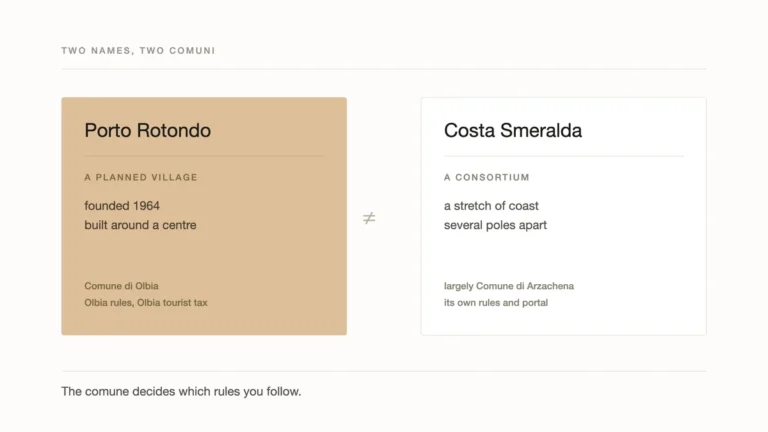
The first thing to know is administrative, and it changes how you should think about the trip: Porto Rotondo is a district of Olbia, not a separate town. It sits on 500 hectares between the gulfs of Cugnana and Marinella, a few kilometres from Golfo Aranci and within easy reach of Arzachena.
It was built, from 1964, by the Venetians Luigi and Nicolò Donà dalle Rose, and the architecture says so: the layout borrows from Venice, and the main square is called piazzetta San Marco. The marina has 800 berths. Around a thousand people live here in winter; in summer the villas and residences push that towards thirty thousand.
As a day out it is modest and pleasant rather than demanding: the village, the marina, the coastline around it. Half a day is honest. Its real distinction is practical — see the section on travelling without a car below.
Golfo Aranci
At the north-eastern tip of the gulf, a few kilometres from Olbia, Golfo Aranci occupies a tongue of land that ends at Capo Figari. It became a comune only in 1979 and has about 2,500 residents; before tourism it was a fishing village, and before that a Roman port.
The name is a cartographers’ mistake. Gulfu di li Ranci means “gulf of the crabs” in Gallurese; mid-twentieth-century mapmakers read it as aranci, oranges, and the oranges stayed.
What makes it a day rather than a stop is Capo Figari itself: a nature oasis that is habitat to mouflon and rare birds, taking in the facing islet of Figarolo, and good for walking. The promontory carries wartime fortifications and a lighthouse, the Semaforo of the Italian Navy, where Guglielmo Marconi ran experiments in 1932 — the village remembers him with a granite sculpture, the Colonna di Luce. Divers go to the Roccia del Mamuthone and Capo Filasca. There is also a Nuragic sacred well, the pozzo sacro di Milis, dated to the seventh and sixth centuries BC.
Costa Smeralda and Porto Cervo
The Costa Smeralda is not a town, and treating it as one leads to a frustrating day. It is a stretch of coast, and administratively it belongs to the comune of Arzachena, which is where you should aim if you want somewhere to arrive at.
Porto Cervo is the closest thing to a centre: a coastal district of Arzachena with a few hundred residents, described by the regional tourist board as the capital of the Costa Smeralda. It grew around a natural inlet whose shape suggested a deer — cervo — and the old port dates from the 1960s, when Prince Karim Aga Khan IV bought this stretch of Gallura and worked with the French set designer Jacques Couelle on what became a deliberately designed village. In summer it is yachts, shopping and events, golf and sailing in particular.
Arzachena’s other coastal districts are worth knowing by name, because they are what you will actually drive through: Baja Sardinia, Cannigione — a fishing village turned resort — Abbiadori, and Poltu Quatu, a modern marina in a fjord-like inlet.
Geasar, which runs Olbia airport, puts the Costa Smeralda at 34 km from the airport. There is no urban bus line to Porto Cervo, so this is a car, taxi or organised-transfer day.
Arzachena and its Nuragic landscape
If you want one full day out of Olbia with real substance, this is it. Arzachena lies 25 kilometres from Olbia and has around 14,000 winter residents. The old town is granite and white stone, small squares and flowered corners; the surrounding hills are vineyards, and this is Vermentino di Gallura country. Around the town are the stazzi, the traditional rural holdings, many now guesthouses and farm stays.
What sets Arzachena apart is the density of its archaeology. The regional tourist board lists seven separate Nuragic and pre-Nuragic sites around this one town, each with its own entry:
| Site | What it is |
|---|---|
| La Prisgiona | The outstanding one. A fortress, a large village and a funerary monument on a granite rise, occupied from the fourteenth to the eighth century BC, with a brief late-Roman reoccupation. The region calls it one of the most significant Nuragic sites in Gallura and in all north-eastern Sardinia |
| Li Lolghi | A giants’ tomb about seven kilometres west of the town, with the characteristic arched central stele. Among the most important and best preserved in Sardinia, not only in Gallura |
| Coddu Vecchiu | The other celebrated giants’ tomb around Arzachena |
| Nuraghe Albucciu | A nuraghe close to the town |
| Tempio di Malchittu | A prehistoric temple building |
| Circoli di Li Muri | Pre-Nuragic stone burial circles |
| Li Mizzani | A further giants’ tomb |
These are archaeological areas rather than museums, and each keeps its own calendar, which also shifts with the season. Confirm the ones you have picked the day before, and resist the urge to attempt all seven: two or three, plus the town itself, makes a well-judged day.
Tavolara and the marine protected area
Tavolara is the limestone mass that closes Olbia’s gulf to the south-east, and you will have been looking at it from the moment you arrived. It falls inside the Tavolara – Punta Coda Cavallo Marine Protected Area, whose boundaries take in more than 15,000 hectares of water.
For a day out the practical consequence is the zoning: permissions are not uniform across the reserve, and anchoring, diving and fishing each follow the level of protection in force where you happen to be. If you are going under your own sail, check the official zoning first. For everyone else the straightforward answer is an authorised operator leaving from the coast, who knows the zones and holds the permits.
The La Maddalena archipelago
Further north, the archipelago is a national park, taking in several islands including Caprera, and it is reached by sea from the Gallura coast. It is a full day and it needs planning, because the crossings are run by operators on seasonal timetables rather than by the park itself.
Two things to know before you commit. Drones are banned across the park — the park authority prohibits overflight, including by remotely piloted aircraft, throughout its territory. And the park has visitable facilities on land, with opening calendars that change by season, so check the park’s own site rather than assuming.
Can you take day trips from Olbia without a car?
For some of them, yes — but be honest about which.
Porto Rotondo is the genuinely car-free day trip. It sits on ASPO’s urban line 05, which means the city bus network reaches it: you are not depending on a coach, a hire car or anyone’s timetable but the town’s own.
Porto Cervo and the Costa Smeralda are not. No urban line serves them, so without a car it is a taxi or an organised transfer.
The boat trips sidestep the question entirely. Tavolara and La Maddalena are reached by operator in any case, so not having a car costs you nothing except the transfer to the departure point.
For longer distances, ARST runs coach services from the Isola Bianca port, with a ticket machine in the maritime station. Which routes run, and how often, changes with the season, and the return time is what decides whether a day trip works at all. Our guide to getting around Olbia covers the networks properly. Times and frequencies belong to the operators, who revise them, so treat theirs as the only ones worth planning around.
What is too far for a day trip
Sardinia is larger than it looks on a map, and the island’s other cities are a different kind of journey. The Port Authority publishes road distances from the port: Alghero Fertilia at 130 km, with an estimated hour and a half by car, and Cagliari at about 276 km.
Cagliari, on those numbers, is not a day trip: between going and coming back the day is the journey, and it deserves a night. Alghero is feasible if you leave early, and so is Sassari on the same western road, but these are long days rather than easy ones, and they sit at the edge of what this base can comfortably do.
Frequently asked questions
What are the best day trips from Olbia?
It depends on the kind of day you want. For the coast and a marina, Porto Rotondo or Golfo Aranci. For the famous coastline and its architecture, the Costa Smeralda and Porto Cervo. For archaeology, Arzachena, which has seven listed Nuragic and pre-Nuragic sites. For the sea, Tavolara or the La Maddalena archipelago by boat.
Can you visit the Costa Smeralda from Olbia in a day?
Yes, easily, provided you have a car. The Costa Smeralda is a stretch of coast rather than a town, administratively part of Arzachena, and Geasar puts it at 34 km from Olbia airport. There is no urban bus line, so it is a car, taxi or transfer day.
Can you visit Porto Cervo from Olbia?
Yes. Porto Cervo is a coastal district of Arzachena and the main centre of the Costa Smeralda, built from the 1960s around a natural inlet. It needs a car, a taxi or a transfer: no city bus line reaches it.
Do you need a car for day trips from Olbia?
For most of them, yes. The exception is Porto Rotondo, which ASPO’s urban line 05 serves directly. Boat trips to Tavolara and La Maddalena run with operators, so a car is not the deciding factor there either.
Is Golfo Aranci worth a day trip from Olbia?
If you want to walk, dive or look for wildlife, yes. Capo Figari is a nature oasis with mouflon and rare birds, facing the islet of Figarolo, and the promontory carries the lighthouse where Marconi experimented in 1932. If you only want a beach, it is a shorter outing than a day.
How far is Arzachena from Olbia?
25 kilometres, according to the regional tourist board. It is the comune the Costa Smeralda grew out of, and the base for the archaeological sites around it, including La Prisgiona and the giants’ tomb of Li Lolghi.
Read also
- Things to do in Olbia: the city beyond the port
- The best beaches near Olbia, and how to reach them
- Best time to visit Olbia: a month-by-month guide
- Where to stay in Olbia: the areas, and who each one suits
- All our English guides to Olbia and north-east Sardinia
A well-chosen base shortens every trip
Everything on this page starts from the same doorstep, which is why where you sleep quietly decides how much of it you get. Ten minutes saved on the way out is twenty across the day, and in August it is more than that. Our guide to where to stay in Olbia compares the areas with exactly this in mind.
AirAffitti manages apartments and rooms in Olbia and Porto Rotondo. Tell us what you want to see and how you plan to move, and we will tell you which side of town to start from — or you can see what we have available.
AirAffitti editorial team