Property Owners
How Much Can a Holiday Rental in Olbia Earn?
What a holiday let in Olbia realistically takes, why the nightly rate tells you little, and where the official figures say the growth actually is.
In short. A well-placed, professionally managed two-room flat in Olbia typically takes somewhere between €12,000 and €20,000 gross a year — that is the order of magnitude we see in our own managed portfolio, not a market statistic. The number that decides where you land is not your nightly rate. It is how many of the available nights you actually sell, and how much of the year your calendar is open. The official figures show why: Sardinia’s winter months account for barely 4% of the island’s annual guest nights, while the shoulder season is the part growing fastest.
Why the nightly rate tells you almost nothing
“I don’t go below €150 a night” is the least useful thing an owner can tell you, and it is the first thing most of them say. A nightly rate on its own is not a result. It becomes a result only when you multiply it by the nights you actually sell.
| Property | Average rate | Occupancy | Revenue over 30 nights |
|---|---|---|---|
| A — “I won’t go lower” | €150 | 45% | €2,025 |
| B — managed pricing | €110 | 85% | €2,805 |
Property B charges 27% less per night and takes 38% more over the month. Ask the owner of A and they will tell you their flat is worth more — and in a sense they are right. It is worth more and it earns less.
So there is really only one figure to watch: revenue per available night. What you take, on average, across every night the property could have been booked, empty or full. It is the only measure that does not let you flatter yourself.
What the official figures say about the season
That Olbia’s season is concentrated is not an impression, and it is worth seeing the real numbers before planning around it.
On ISTAT data for 2025, reported by the Regione Sardegna, the island closed the year with over 5 million arrivals and around 22 million guest nights, at an average stay of 4.24 nights. Guest nights were up 15.9% on 2024 and 34.2% on 2023 — the strongest growth of any Italian region.
Two things in that release matter more than the headline:
- Winter is genuinely thin. In the winter months guest nights stay under one million across the whole island — about 4% of the annual total. Anyone promising you a year-round holiday-let calendar in Gallura is selling something.
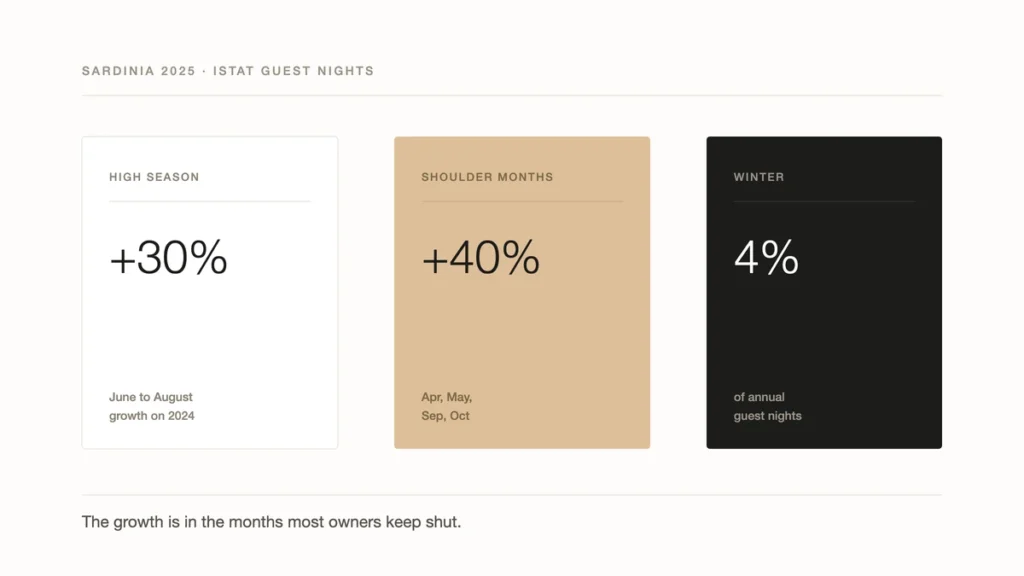
- The shoulder season is growing fastest. Between 2024 and 2025 guest nights grew around 30% in high season (June, July, August) and about 40% in the middle season — April, May, September and October.
Read together, those two facts set the strategy. The money is still made in summer, but the growth is in the months on either side of it, and those are the months most owners leave closed.
Olbia also has something the purely seaside towns nearby do not: a quieter, steadier demand through the rest of the year, tied to the airport, the port and the hospital. A property at Golfo Aranci lives almost entirely off the summer. A flat in Olbia itself can keep breathing.
A worked example, season by season
A two-room flat ten minutes from Pittulongu, sleeping four, with dynamic pricing. These figures are an illustration built on realistic values for this kind of property, not a market survey. They show how a year is put together; they do not promise a result.
| Period | Average rate | Occupancy | Revenue |
|---|---|---|---|
| June | €95 | 75% | €2,140 |
| July | €135 | 90% | €3,770 |
| August | €175 | 96% | €5,210 |
| September | €90 | 70% | €1,890 |
| Rest of the year (243 nights) | €55 | 35% | €4,680 |
That totals roughly €17,700 gross. The same flat let by word of mouth in August alone would stop somewhere around €4,500.
Now look at the last row, because it surprises people. The so-called dead months are worth €4,680 — slightly more than August — on low rates and 35% occupancy. They are eight months that together carry a quarter of the year’s revenue. An owner who opens the listing in June and closes it in September is not losing a little at the margins: they are leaving out the largest single block of income after August.
The levers that actually move the number
- Location — town, coast or countryside. It sets the nightly rate, but above all it sets how long your season can be.
- Dynamic pricing — the most underrated of the five. The same week can be worth €80 a night in June and €180 in mid-August; a single fixed summer rate gives August away and undersells September.
- Photographs and listing copy — the first booking always comes through the eyes.
- Reviews — above 4.8 stars the platforms reward you with visibility.
- Response speed — measured in minutes, not days.
The order is not accidental. You cannot change the location; you can switch on dynamic pricing tomorrow. Four of the five levers depend on how the property is run, not where it is — which is why two flats on the same landing can finish the year thousands of euro apart.
The first year is not like the others
The figures above describe a property in its stride, not in its first month. A new listing starts with no reviews and no history: the algorithm does not yet know what you are, and the first bookings have to be bought with a sharper rate than the property deserves.
So the first year is worth less than the ones after it, and that should be in the plan from the start rather than come as a disappointment. The first handful of reviews is the most profitable investment you will make: after them, the same flat on the same calendar starts selling the same nights at higher rates. Owners who give up halfway through the first season, because it is “not earning what they said”, leave precisely one moment before it starts to pay.
Gross is not what you keep
Everything above is gross booking revenue. Before it becomes yours, four things come out of it, and for a non-resident owner three of them are easy to underestimate:
- Platform commission, deducted before the money reaches you.
- Running costs — cleaning between stays, laundry, utilities, maintenance.
- Tax on the income. Italy taxes short-let income at 26%, or 21% on one property you nominate each year: our guide to the cedolare secca explains how it works and what the platform withholds.
- IMU, the municipal property tax, which you pay on ownership whether the flat is busy or empty. In Olbia short lets pay the full rate, and on a typical flat that is around €1,400 a year. On gross revenue of €17,700 that is roughly 8% gone before anything else.
The tourist tax is in a different category again: your guests pay it, you collect it and hand it to the comune. It is not your income and it is not your cost, but it is your responsibility — and it does add to what the guest sees at checkout.
The practical consequence is simple. Comparing the gross revenue of a holiday let with the annual rent of a long let is comparing two numbers that are not comparable. The holiday let usually still wins in Gallura, and often by a wide margin, but it wins by less than the gross figures suggest.
Frequently asked questions
How much does a two-room flat in Olbia earn?
Well managed, in the order of €12,000 to €20,000 gross a year, helped by the double demand: tourism in summer and work-related stays through the rest of the year. That is the range we see in our own managed properties rather than a published market average, and the outcome depends heavily on the property and the management.
Is short letting better than a long-term tenancy?
In Olbia a well-run short let generally produces materially more than an annual rent, at the cost of considerably more work — which can be delegated. The comparison has to be made net of tax, IMU and running costs, not on gross figures.
Why does my neighbour earn more with the same flat?
Almost always a combination of three things: they update their prices, they have more reviews, and they answer in minutes. None of the three depends on the property. All three are recoverable.
Does the first year earn like the others?
No, and it should not worry you. Without reviews or history the platforms show you less, so the first bookings are won with lower rates. From roughly the sixth review onwards the same calendar sells at higher prices.
Are the winter months worth opening for?
Across Sardinia the winter accounts for under 4% of annual guest nights, so no one should plan a winter season. The months to fight for are the shoulder ones — April, May, September and October — where guest nights grew about 40% between 2024 and 2025, against about 30% in high season.
What is revenue per available night?
What you take on average across every night the property was bookable, whether or not it sold. It combines rate and occupancy into one figure, which is why it is harder to fool yourself with than a nightly rate.
Is the figure I see on the platform what I earn?
No. What reaches your account is already net of commission and, where a platform withholds it, net of the 21% withholding tax. Your taxable base is the gross rent, which is higher than the figure on your statement.
The short version
The nightly rate is vanity; revenue per available night is the result. The season in Gallura is genuinely concentrated — the official figures put the island’s winter at 4% of annual guest nights — but the shoulder months are the fastest-growing part of the market and the part most owners leave shut. And whatever the gross figure, what you keep is after commission, costs, income tax and IMU.
Own a property in Olbia and want to know what it could realistically take? AirAffitti runs the operational side of short-term letting — listings and pricing, guest communication, check-in coordination, cleaning between stays, and the day-to-day administrative workflow that comes with stays. What our management covers sets out the detail, and we can put a realistic calendar and a gross figure against your specific property rather than against an average.
What we are not is a tax adviser or an investment adviser, and nothing here is a forecast of your returns. The figures above are illustrative, and no two properties in Olbia perform alike.
Sources
- Regione Autonoma della Sardegna, press release of 23 July 2026, reporting ISTAT data for 2025: arrivals, guest nights, average stay of 4.24 nights, growth by season, and the winter share of annual guest nights.
- Revenue figures and ranges: AirAffitti’s own managed portfolio, stated as such and not as market statistics.
This guide is for information only. The worked example is an illustration, not a projection, and past performance of other properties is not a guide to what yours will earn.